Forex Spreads at 5 PM ET: How Much They Widen at Rollover (Data Study)
Forex spreads explode at the 5:00 PM ET daily rollover. We measured every tick of October 2026: EUR/USD’s median spread was 0.2 pips during the 8 AM to 12 PM ET session but 4.6 pips between 5:00 and 5:10 PM, about 23 times wider. GBP/USD widened about 16 times (0.5 to 8.1 pips) and USD/JPY about 24 times (0.3 to 7.3 pips). Spreads stay elevated until roughly 6:00 PM ET, then return to normal.
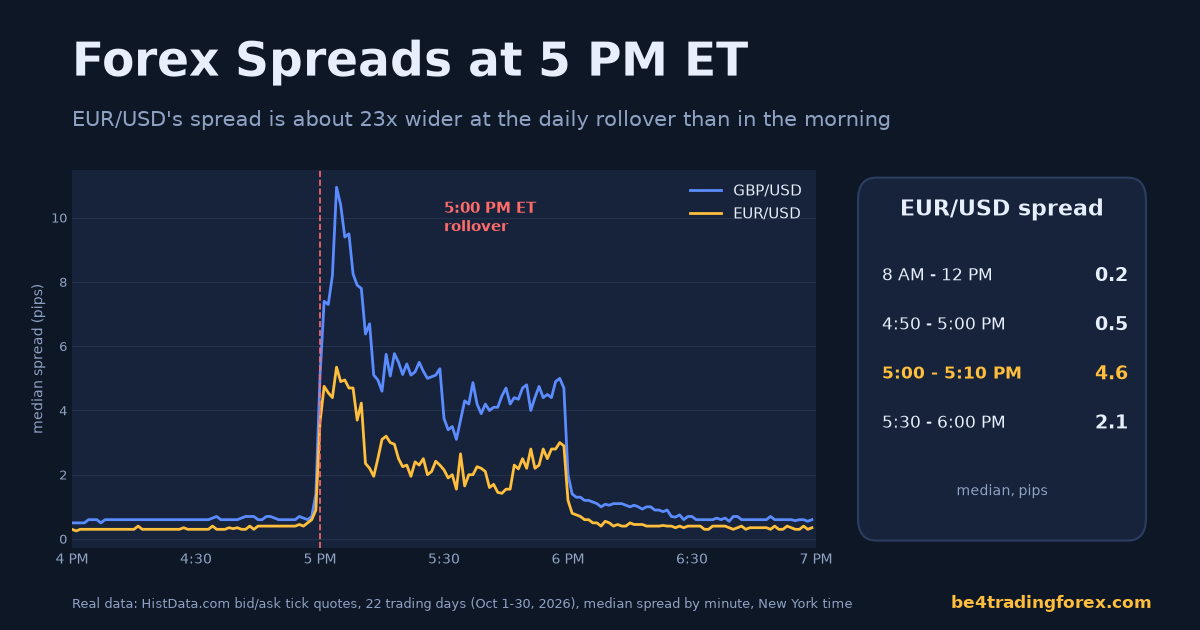
Every forex trader is told that spreads widen at the rollover. But by how much, for how long, and on which pairs? We measured it with tick-by-tick bid and ask prices for 22 trading days. Below are the numbers, what they cost you in dollars, and what to do about them. How we measured is at the end.
Results: Median Spreads Through the Day
| Time (New York) | EUR/USD | GBP/USD | USD/JPY |
|---|---|---|---|
| London morning, 3:00 – 8:00 AM | 0.2 pips | 0.5 pips | 0.4 pips |
| London + New York, 8:00 AM – 12:00 PM | 0.2 pips | 0.5 pips | 0.3 pips |
| New York afternoon, 12:00 – 4:00 PM | 0.2 pips | 0.5 pips | 0.35 pips |
| Last 10 minutes, 4:50 – 5:00 PM | 0.5 pips | 0.7 pips | 0.7 pips |
| Rollover, 5:00 – 5:10 PM | 4.6 pips | 8.1 pips | 7.3 pips |
| 5:10 – 5:30 PM | 2.5 pips | 5.4 pips | 4.5 pips |
| 5:30 – 6:00 PM | 2.1 pips | 4.3 pips | 4.1 pips |
| Evening, 7:00 – 10:00 PM | 0.3 pips | 0.5 pips | 0.4 pips |
Three things stand out:
- The jump is sudden. Spreads start creeping up about 10 minutes before 5:00 PM, then jump in the first minutes after it. The single widest minute was 5:04 PM on EUR/USD and GBP/USD (median 5.4 and 11.0 pips) and 5:01 PM on USD/JPY (9.0 pips).
- Bad days are much worse than the median. At 5:04 PM, one day in ten saw EUR/USD’s spread at 13.7 pips or more.
- It lasts about an hour. Spreads ease after 5:10 PM but stay several times above normal until about 6:00 PM ET, when they drop back to near their daytime levels.
What the Rollover Spread Costs You
The spread is paid every time you open a trade. Here is the same one-standard-lot trade (100,000 units) opened at two different times:
| Pair | Cost at 8 AM – 12 PM | Cost at 5:00 – 5:10 PM |
|---|---|---|
| EUR/USD ($10 per pip) | 0.2 pips = $2 | 4.6 pips = $46 |
| GBP/USD ($10 per pip) | 0.5 pips = $5 | 8.1 pips = $81 |
| USD/JPY (about $6.33 per pip at 158.00) | 0.3 pips ≈ $2 | 7.3 pips ≈ $46 |
On a micro lot (0.01) divide by 100: still the difference between 2 cents and 46 cents on every EUR/USD trade. The pip value calculator converts any spread into dollars for your position size.
Why Spreads Widen at 5 PM ET
5:00 PM New York time is the end of the forex trading day. Banks settle the day’s positions, credit or charge overnight swap, and many liquidity providers pull their quotes for a few minutes. With fewer prices in the market, the gap between the best bid and the best ask grows. New York has just closed and Tokyo has not yet opened, so there is little natural trading to fill it. The same thing happens at the weekly open: in our data, the median spread between 5:00 and 5:10 PM on Sundays was 3.3 pips on EUR/USD, 9.2 on GBP/USD and 12.2 on USD/JPY. See liquidity in forex for the background.
What It Means for Your Trading
- Don’t open trades between about 4:50 and 6:00 PM ET. Wait until spreads are back to normal; nothing in your setup is worth paying 20 times the usual cost.
- Watch your stops. A long position is closed at the bid. When the spread widens, the bid can drop by several pips with no real move in the market, and tight stop-losses get hit. Keep stops beyond the normal spread range, as explained in where to place a stop-loss.
- Pending orders can fill at bad prices. A buy stop triggers on the ask: a widening spread can trigger it even if the bid never reached your level. See forex order types.
- Expert advisors need a time filter. Robots that trade around the clock should skip the rollover window. Our guide to expert advisors covers the basics.
- Trade when spreads are tight. The tightest spreads are during the London and New York sessions, which are also the most active hours: see the best time to trade forex.
How We Measured
We used free tick-by-tick bid and ask quotes from HistData.com for EUR/USD, GBP/USD and USD/JPY for October 1–30, 2026: 22 trading days. For every tick, spread = ask − bid, in pips. For each day and each minute we took the median spread, then the median of that minute across all 22 days, so a single extreme day can’t distort the result. The time stamps were checked against the 5:00 PM New York rollover, which appears exactly where it should. These quotes come from one data feed with tight, institutional-style spreads. Most US retail brokers quote wider spreads all day, so your own numbers will be higher, but the pattern (a sharp spike at 5:00 PM ET that fades by 6:00 PM) is a feature of the market, not of one feed. To check your broker, watch its live spread in MT4 or MT5 just after 5:00 PM ET.
Frequently Asked Questions
Why are forex spreads so high at 5 PM?
5:00 PM ET is the daily rollover, when the forex trading day ends. Banks settle positions and many liquidity providers stop quoting for a few minutes, so the best bid and ask move apart. In our October 2026 data, EUR/USD’s median spread rose from 0.2 to 4.6 pips.
How long do spreads stay wide after 5 PM ET?
The worst is the first 10 minutes. Spreads stay several times above normal until about 6:00 PM ET, then return to near their daytime levels.
What time are forex spreads lowest?
During the London and New York sessions. In our data, EUR/USD’s median spread was 0.2 pips from 3:00 AM to 4:00 PM ET.
Do spreads also widen on Sunday when the market opens?
Yes. The weekly open at 5:00 PM ET on Sunday had median spreads of 3.3 pips on EUR/USD, 9.2 on GBP/USD and 12.2 on USD/JPY in the first 10 minutes.
Disclaimer: This study is for educational purposes only and is not financial advice. Spreads vary by broker and market conditions; past spreads do not guarantee future ones. Forex trading carries a high level of risk and may not be suitable for all investors. The CFTC notes that most retail forex customers lose money.
Sources
- Data: HistData.com free ASCII tick data (bid/ask), EUR/USD, GBP/USD and USD/JPY, October 2026, analysed by Be4TradingForex.
- CFTC, Customer Advisory: Eight Things You Should Know Before Trading Forex (PDF).
Free to cite: you may reuse the chart and figures with a link to this page.
Keep learning