What Is a Prop Firm? How Forex Prop Trading Firms Work (US Guide)
A prop firm (proprietary trading firm) lets you trade a larger account after you pass a paid evaluation. You pay a fee, trade under strict rules on profit targets and maximum losses, and, if you pass, you trade a “funded” account and keep a share of the profits. Most retail prop firms are not brokers: many funded accounts are simulated, and the firm’s main income is often evaluation fees. US traders should also check whether a firm accepts US residents at all.
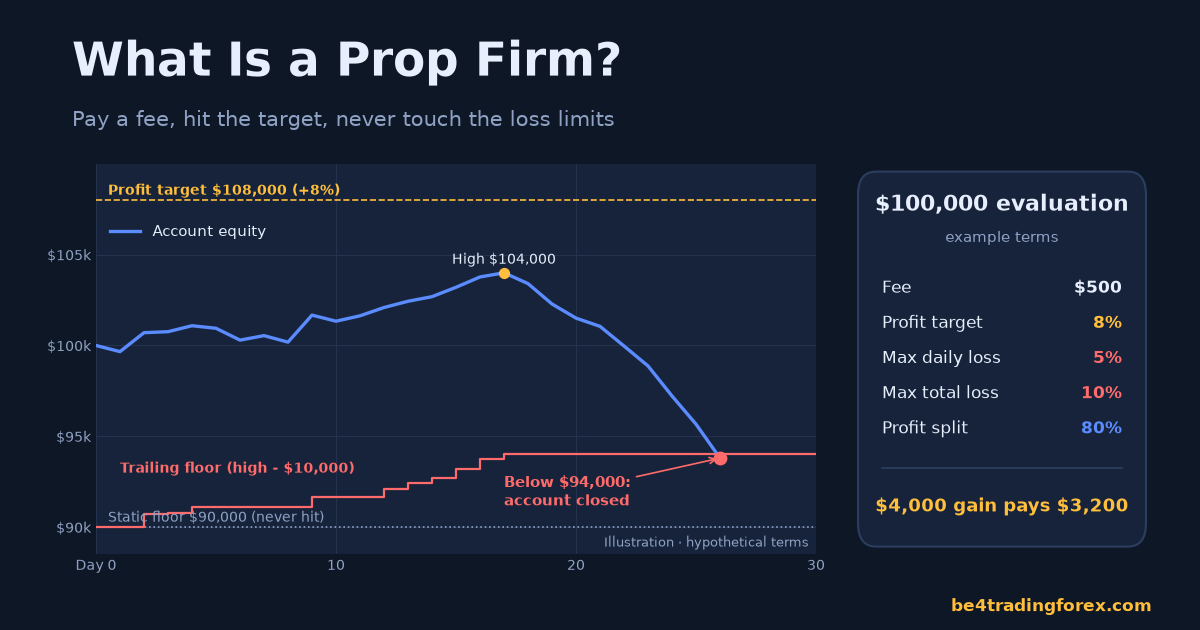
This guide explains how prop firms work, what the rules mean in numbers, how they differ from a regulated US forex account, and the questions to ask before paying a fee. It names no firms and recommends none.
What a Prop Firm Is
“Proprietary trading” originally meant a bank or trading company trading its own money, with salaried traders on its desk; see what professional forex trading is. The online “prop firms” that advertise to retail traders work differently:
- You buy an evaluation (often called a challenge) for a stated account size.
- You must reach a profit target without breaking the loss limits and other rules.
- If you pass, you get a funded account and receive a profit split on gains, often after a minimum number of trading days.
- If you break a rule at any stage, the account is closed and you usually pay again to retry.
In many programs the “funded” account is a demo or simulated account: your trades are copied, hedged or not placed in the market at all, and payouts come from the firm’s own revenue. Read the terms to see exactly what you are buying.
How the Rules Work in Numbers
The table uses hypothetical example terms to show the math. They are not the terms of any specific firm, and real terms vary widely.
| Rule (example) | Setting | On a $100,000 evaluation |
|---|---|---|
| Evaluation fee | One-time | $500 |
| Profit target | 8% | Reach $108,000 |
| Maximum daily loss | 5% of starting balance | Never lose more than $5,000 in one day |
| Maximum total loss | 10% | Never fall below $90,000 |
| Profit split (funded) | 80% to the trader | A $4,000 gain pays $3,200 |
Two details decide most failures:
- How daily loss is measured. Some firms count equity, including open losses, not just closed trades. A trade that dips deep and then recovers can still break the rule.
- Static vs trailing drawdown. A static limit stays at $90,000. A trailing limit rises with your highest balance or equity, so after a run to $104,000 the floor may sit at $94,000, which leaves much less room.
The Risk Math: Why Position Size Matters
An 8% target with a 5% daily limit tempts traders to size up. The numbers say otherwise. Risking 1% per trade, five losses in a row cost about 4.9% and leave you just inside the daily limit; risking 2.5% per trade, two losses take 4.9%. Losing streaks of five or more are normal for most strategies, so a trader who passes by risking big has mostly been lucky.
A rule that works for evaluations and real accounts alike: size every trade from the stop-loss so that a full losing day stays well under the daily limit. The position size calculator does the math, and risk management in forex explains the method.
Prop Firm vs Your Own US Forex Account
| Retail prop firm | Own account at a US forex dealer | |
|---|---|---|
| Upfront cost | Evaluation fee, often repeated after a failure | Your deposit, which stays your money |
| Capital at risk | Only the fee | Your deposit |
| Regulation | Usually not a CFTC-registered dealer; check the terms | CFTC-registered retail foreign exchange dealer and NFA member |
| Leverage and rules | Set by the firm’s terms | Max 50:1 on majors, 20:1 on others; FIFO, no hedging |
| What you keep | A share of profits if paid out | All profits, taxed under US rules |
| Main risk | Losing fees, rule disputes, the firm stopping payouts | Losing your deposit |
For a US trader with a small account, the honest comparison is fee versus deposit. A $500 fee that fails three times costs $1,500, the same as a starting account that you would still own if you traded it carefully. See how much money you need to start forex trading and the US forex trading rules.
Prop Firms and US Traders
- Eligibility. Many prop firms that offer forex or CFD evaluations do not accept US residents, or offer them a different platform. Check before paying.
- Futures prop firms. Some firms run evaluations on futures contracts instead, such as micro FX futures; see micro FX futures vs spot forex.
- Registration. A firm that is your counterparty in retail forex in the US must be registered with the CFTC and be an NFA member. You can check any firm’s status with NFA BASIC and the US broker checklist; most evaluation-fee businesses will not appear there, which tells you they are not regulated as forex dealers.
- Taxes. Payouts from a prop firm are not the same as gains in your own trading account. Ask a tax professional how to report them; our forex tax guide covers your own trading only.
8 Questions to Ask Before Paying a Fee
- Does the firm accept US residents, and in writing?
- Is the funded account live or simulated?
- Is the daily loss based on balance or equity, and when does the “day” reset (in ET)?
- Is the maximum drawdown static or trailing?
- Are news trading, holding over weekends, EAs or copy trading allowed?
- What is the minimum number of trading days, and how long do payouts take?
- Can the firm change the rules or refuse a payout, and on what grounds?
- How long has the firm been paying traders, and what happens to your account if it closes?
Then test your strategy on a free demo under the same limits for a month. If it cannot pass on demo, a fee will not change that. A written trading plan with the firm’s limits built in is the best preparation.
Frequently Asked Questions
What is a prop firm in trading?
A company that gives traders access to a larger account, usually after a paid evaluation, in exchange for a share of the profits and strict risk rules. Many retail programs use simulated accounts.
Are prop firms legit?
Some pay traders for years and some have closed or stopped payouts. The model is legal in many places, but most retail prop firms are not regulated as forex dealers, so you rely on their terms and reputation. Read the rules and pay only what you can afford to lose.
Can US residents use forex prop firms?
Some can, many cannot. Several firms restrict US clients or offer them other platforms, and futures-based programs are a common alternative. Always check eligibility before buying an evaluation.
Do you need your own money to trade with a prop firm?
You need money for the evaluation fee, not for the trading account. That fee is at risk, and repeated attempts add up.
Is a prop firm better than a small live account?
It depends on your results. A trader with a tested, consistent strategy may prefer the larger buying power; a trader still learning usually loses less by trading a small regulated account with tight risk.
General education, not financial advice. Forex and futures trading involves substantial risk of loss and is not suitable for everyone. Only trade money you can afford to lose.
Sources
- CFTC regulations, 17 CFR Part 5: off-exchange retail forex transactions, registration of retail foreign exchange dealers, and security deposits (2% majors, 5% others).
- CFTC, Customer Advisory: Eight Things You Should Know Before Trading Forex: check registration and understand fees before you trade.
- CFTC, Understand Your Contractual Obligations: read the terms before you pay.
- National Futures Association, BASIC search: check whether a firm is registered.
Keep learning