Balance, Equity, Margin, Free Margin and Margin Level in Forex
Balance is the money in your account from closed trades. Equity is your balance plus or minus the floating (unrealized) profit or loss of open trades. Margin is the deposit your broker sets aside to keep those trades open, free margin is equity minus margin, and margin level is equity divided by margin, as a percentage. When margin level falls too low, the broker can stop you from opening trades and then start closing them.
These five numbers sit at the bottom of the Trade tab in MetaTrader, and they tell you more about your risk than any chart. This guide shows what each one means, how they move together, and what happens near a margin call, with a worked example for a US account at 50:1 leverage.
The Five Numbers on Your Account Line
| Number | Formula | What it tells you |
|---|---|---|
| Balance | Deposits − withdrawals + closed (realized) profit/loss | What you would have if every trade were already closed at the last close |
| Equity | Balance + floating profit/loss (including swap) | What the account is worth right now |
| Margin (used margin) | Sum of the margin required by all open positions | Money locked as a deposit for open trades |
| Free margin | Equity − margin | Room left to open new trades or absorb losses |
| Margin level | Equity ÷ margin × 100% | How close you are to a margin call; blank when no trades are open |
If the terms are new, keep the forex glossary open alongside this guide.
Floating vs Realized Profit and Loss
Floating (or unrealized) P/L is the profit or loss of trades that are still open, valued at the current price. It changes with every tick and is included in equity, but not in balance. When you close the trade, it becomes realized P/L and moves into the balance.
Two details catch beginners:
- Floating P/L is valued at the price you would close at: the bid for a buy, the ask for a sell. That is why a new trade starts slightly negative. See bid and ask price explained.
- Overnight financing (swap) charged or credited at the 5:00 PM ET rollover is part of the floating result until the trade is closed.
To turn pips into dollars for any position, use the profit and loss calculator.
How Margin Works at a US Broker
Under CFTC rules, US retail forex dealers must collect a security deposit of at least 2% of the position’s value on major pairs (50:1 leverage) and 5% on other pairs (20:1). Margin is not a fee: it stays in your account and becomes free again when the trade closes. Its size depends on the position, not on your stop-loss. The forex margin calculator works it out for any pair, and the leverage guide explains why lower effective leverage is safer.
Worked Example: One Standard Lot of EUR/USD
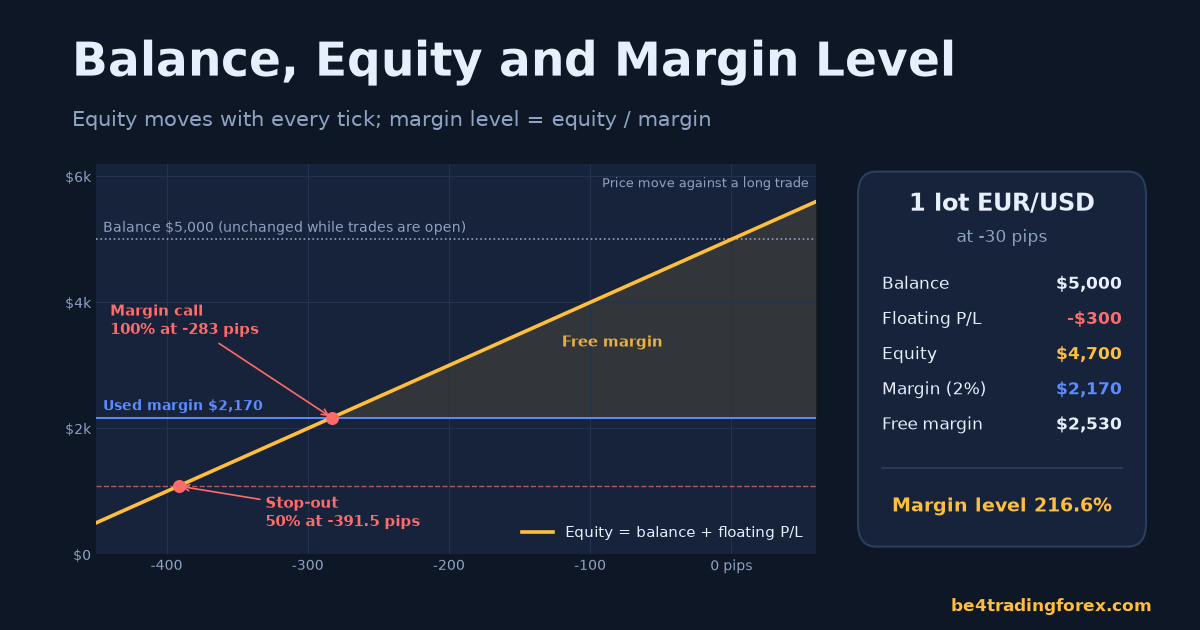
You have a $5,000 balance and buy 1 standard lot of EUR/USD at 1.08500. The position is worth $108,500, so the required margin at 2% is $2,170. One pip is worth $10.
| Situation | Floating P/L | Equity | Margin | Free margin | Margin level |
|---|---|---|---|---|---|
| Price +45 pips | +$450 | $5,450 | $2,170 | $3,280 | 251.2% |
| Price −30 pips | −$300 | $4,700 | $2,170 | $2,530 | 216.6% |
| Price −283 pips | −$2,830 | $2,170 | $2,170 | $0 | 100% |
| Price −391.5 pips | −$3,915 | $1,085 | $2,170 | −$1,085 | 50% |
The balance stays at $5,000 the whole time, because nothing has been closed. Only equity, free margin and margin level move. Notice how much damage one full standard lot can do to a $5,000 account: a 283-pip move, which EUR/USD can travel in a few volatile weeks, wipes out all free margin. At 1% risk per trade with a sensible stop, this account would trade far smaller, as the position size calculator shows.
Margin Call and Stop-Out
Brokers set two thresholds based on margin level:
- Margin call level: below it you can no longer open new trades and you may get a warning. Many platforms use 100%, the point where free margin reaches zero.
- Stop-out (liquidation) level: below it the broker starts closing your positions at the market price, usually the largest losing trade first, until margin level recovers.
The exact levels differ from broker to broker and are written in your customer agreement; US dealers generally liquidate once equity can no longer cover the required security deposit. A stop-out is not a risk plan: it closes trades at the worst moment, after most of the damage is done, and fast markets or weekend gaps can push equity even lower before positions are closed.
How to Keep Margin Level Safe
- Size from the stop-loss, not from free margin. Free margin tells you what you can open, not what you should. Risk a fixed small share of equity per trade; see risk management in forex.
- Watch total exposure. Several trades in correlated pairs (EUR/USD and GBP/USD, for example) use margin and lose money together.
- Use real stops. A stop-loss closes one trade at your price; a stop-out closes everything at the broker’s. See where to place a stop-loss.
- Be careful around news and weekends. Spreads widen and prices can gap, which lowers equity suddenly.
- Keep a cushion. Many disciplined traders keep margin level in the high hundreds or thousands of percent, with used margin a small fraction of equity.
Where to Find These Numbers in MetaTrader
In both MT4 and MT5, open the Toolbox (Ctrl+T) and the Trade tab. The line under your positions shows Balance, Equity, Margin, Free Margin and Margin Level. Right-clicking the tab lets you add columns such as swap and commission. On the mobile app, the same figures appear at the top of the Trade screen. New to the platforms? Compare them in MT4 vs MT5.
Frequently Asked Questions
What is the difference between balance and equity?
Balance counts only closed trades. Equity adds the floating profit or loss of open trades, so it shows what the account is worth right now. With no open trades, the two are equal.
What does unrealized P&L mean in forex?
It is the profit or loss of open positions at the current price, also called floating P/L. It becomes realized when you close the trade and is then added to or taken from your balance.
What is a good margin level?
There is no single number, but higher is safer. A margin level near 100% means free margin is gone and a margin call is close. Traders who size positions from their stop-loss usually sit far above that.
Why is my free margin negative?
Because floating losses have pushed equity below the margin used. You cannot open new trades, and if margin level keeps falling the broker will start closing positions.
Can I lose more than my balance?
In a fast market or a weekend gap, positions can close below zero equity. Some dealers offer negative balance protection and some do not, so read your customer agreement. Small position sizes are the real protection.
General education, not financial advice. Forex trading involves substantial risk of loss and is not suitable for everyone. Only trade money you can afford to lose.
Sources
- CFTC regulations, 17 CFR 5.9, Security deposits for retail forex transactions: 2% on major currencies, 5% on others.
- CFTC, Customer Advisory: Eight Things You Should Know Before Trading Forex: leverage, margin and the risk of losing your deposit.
- National Futures Association, Compliance Rule 2-36: requirements for forex dealer members, including cost disclosure and fair dealing with customers.
- MetaQuotes, MetaTrader 5 Help: Basic Principles of trading operations: account and margin terms.
Keep learning