Forex Fundamental Analysis: How Economic Data Moves Currencies

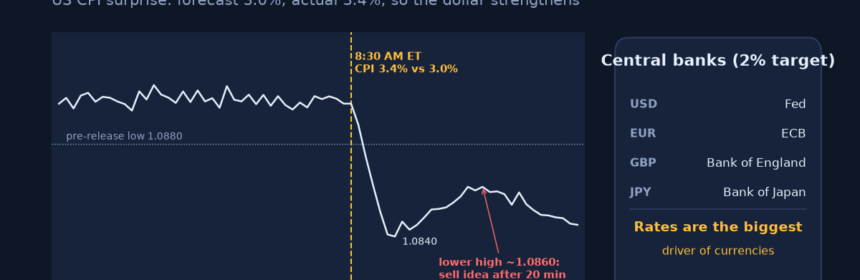
EUR/USD reacting to a US CPI surprise at 8:30 AM ET: forecast 3.0%, actual 3.4%, price drops from 1.0900 to 1.0840, then forms a lower high near 1.0860

Fundamental analysis in forex is the study of the economic forces that move currencies: interest rates, inflation, growth, employment and the decisions of central banks. Where technical analysis asks when to trade, fundamental analysis asks why a currency should rise or fall. This guide explains how economic data moves currency pairs, which releases matter most, how to read the economic […]

Read more about Forex Fundamental Analysis: How Economic Data Moves Currencies

Forex Trading Using Intermarket Analysis by Louis B. Mendelsohn: Book Review and Key Lessons

Forex Trading Using Intermarket Analysis by Louis B. Mendelsohn: Book Review and Key Lessons

Forex Trading Using Intermarket Analysis is a compact guide by Louis B. Mendelsohn, published by Marketplace Books in 2006. It argues that currency traders who study one chart in isolation miss important information carried by related markets. Forex traders who want to understand how interest rates, commodities, stock indexes and other currency pairs can influence the pair they trade may […]

Read more about Forex Trading Using Intermarket Analysis by Louis B. Mendelsohn: Book Review and Key Lessons

What Is Fundamental Analysis in Forex? An Overview

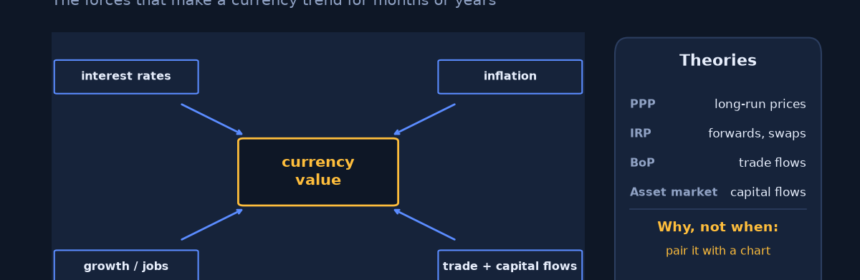
Diagram of the forces behind a currency's value: interest rates, inflation, growth and jobs, and trade and capital flows

Fundamental analysis studies the economic and political forces that set the value of a currency over time. It explains why exchange rates trend for months or years: differences in interest rates, inflation, growth, trade and capital flows, and the policies of central banks and governments. This overview covers the main theories behind currency values, the forces that drive long-term trends, […]

Read more about What Is Fundamental Analysis in Forex? An Overview

How Market Analysis Works in Forex

Exchange rates move because money flows between countries. Interest rates, inflation, growth, trade and risk sentiment decide where that money goes. Market analysis is the habit of following those forces so a chart pattern is not your only reason for a trade.

The Three Layers

  1. Fundamentals. Begin with what fundamental analysis is, then see how economic data moves currencies: central bank decisions, CPI inflation, jobs reports and GDP.
  2. Intermarket links. Currencies move with other markets. Read currencies and crude oil (CAD and NOK), the currency correlation strategy, and the review of Forex Trading Using Intermarket Analysis.
  3. Timing with the chart. Fundamentals give a direction; technical analysis gives the entry, stop and target.

What Moves the Major Pairs

  • Interest-rate expectations: a currency tends to strengthen when markets expect its central bank to raise rates or keep them higher for longer.
  • US data releases: the jobs report, CPI and Federal Reserve meetings move every USD pair. Most US releases come out at 8:30 AM Eastern Time; check the forex market hours in ET to see which session they hit.
  • Risk sentiment: in stressed markets traders often buy the US dollar, Japanese yen and Swiss franc and sell higher-yielding currencies.
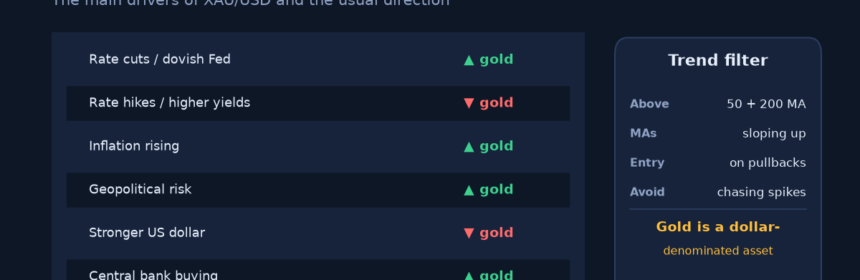
  • Commodities: oil affects the Canadian dollar, and gold tends to move against the dollar. See gold trading today.

Market Analysis FAQ

Do I need fundamentals to trade short-term?

You need at least the economic calendar. Spreads widen and price can jump through stops in the minutes around a major release, so many short-term traders simply stay flat during them.

Which is more important, fundamental or technical analysis?

They answer different questions. Fundamentals explain why a currency is trending over weeks; the chart shows where to enter and where your idea is wrong. Most professionals use both.