Forex Arbitrage Explained: Triangular, Latency and Interest Rate Arbitrage
Arbitrage is the closest thing finance has to “free money”: buying something in one place and selling it for more somewhere else at the same moment, with no market risk. In forex, arbitrage opportunities do exist, but they are tiny, they last fractions of a second, and they are captured by banks and high-frequency trading firms long before a retail trader could click a button. This guide explains the main types of forex arbitrage with worked numbers, why they rarely work for retail traders, and the arbitrage-like strategies that are realistic for individuals.
What Is Forex Arbitrage?
Forex arbitrage means profiting from a price inconsistency: the same currency, or the same combination of currencies, priced differently at the same time. A true arbitrage trade has three features:
- The buy and sell happen simultaneously, so there is no exposure to the market moving.
- The profit is locked in when the trades are placed.
- It requires no forecast of where prices will go.
Because arbitrage is risk-free in theory, the moment a gap appears, large players with the fastest connections close it. That competition is exactly what keeps currency prices consistent across the world.
Type 1: Triangular Arbitrage
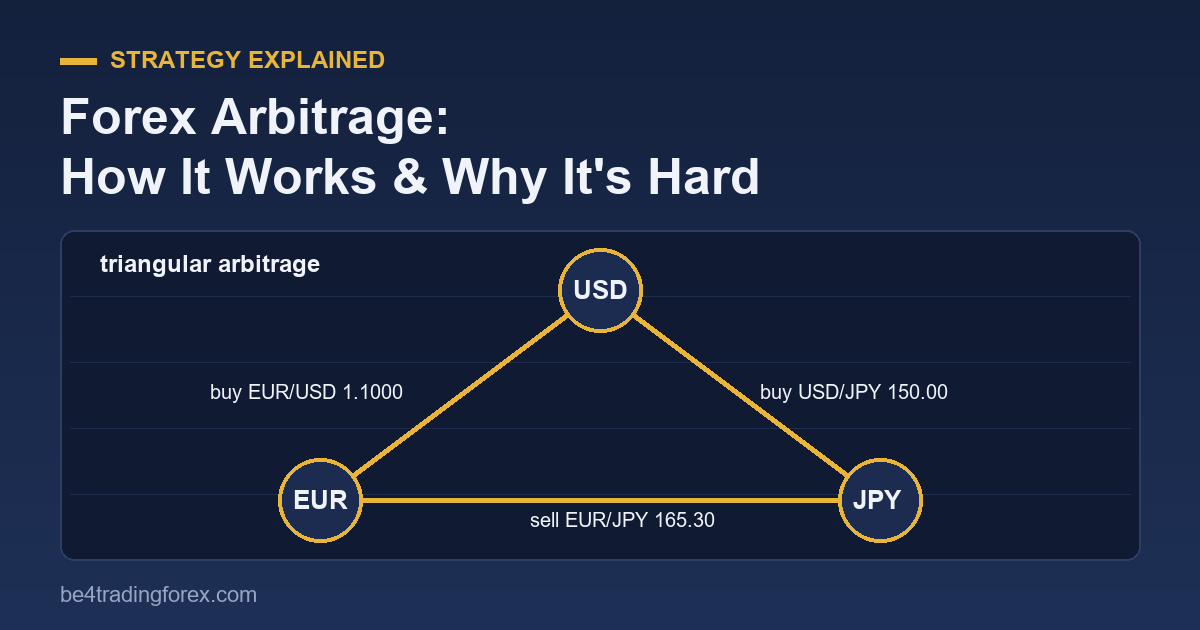
Three currency pairs are linked. For example, the EUR/JPY rate should equal EUR/USD multiplied by USD/JPY. If the quoted cross rate drifts away from this implied rate, you can trade around the triangle and end up with more of the currency you started with.
Worked example (prices simplified, no spreads):
| Pair | Quote |
|---|---|
| EUR/USD | 1.1000 |
| USD/JPY | 150.00 |
| Implied EUR/JPY (1.1000 × 150.00) | 165.00 |
| Quoted EUR/JPY | 165.30 |
EUR/JPY is quoted 30 pips above its implied value, so:
- Sell €1,000,000 for yen at 165.30 → ¥165,300,000.
- Sell the yen for dollars at 150.00 → $1,102,000.
- Sell the dollars for euros at 1.1000 → €1,001,818.
Profit: about €1,818 before costs. In reality, a gap this size between major pairs would be closed almost instantly, and each of the three trades pays a spread. On real quotes the inconsistencies are usually smaller than the combined spreads, so the “profit” disappears.
Type 2: Two-Point (Spatial) Arbitrage
The same pair is quoted slightly differently by two dealers: buy at the cheaper one, sell at the more expensive one. In today’s electronic market, dealer prices are synchronised in milliseconds, so the differences are usually smaller than the spread.
A retail version, often called latency arbitrage, tries to exploit a slow broker feed by trading against a faster price source. Most retail brokers prohibit this in their terms and can cancel the profits or close the account. Software sold as an “arbitrage EA” that promises steady profits from this is a common trap.
Type 3: Covered Interest Arbitrage
Exchange rates for future delivery (forwards) are linked to the interest rates of the two currencies. This is called interest rate parity: the forward rate should equal the spot rate adjusted for the interest-rate difference. If it does not, an institution can borrow the low-rate currency, convert it, invest at the higher rate and lock in the future exchange rate with a forward contract, earning a risk-free profit.
This needs access to interbank borrowing, deposits and forward contracts, so it is an institutional strategy. It is worth understanding, though, because it explains why swap (rollover) rates on your trading account exist: holding a position overnight earns or pays the interest-rate difference between the two currencies.
Arbitrage-Like Strategies Retail Traders Can Use
These are not risk-free arbitrage, but they use the same idea of related prices drifting apart and coming back.
Statistical arbitrage (pairs trading)
Two closely correlated pairs, such as EUR/USD and GBP/USD, normally move together. When their relationship stretches far from its usual range, traders buy the relatively weak pair and sell the relatively strong one, expecting the gap to close. The risk is that the correlation breaks down, for example after a central bank surprise, so it needs a stop loss like any other trade. Our currency correlation strategy guide shows how to measure correlation and trade divergences.
Carry trade
Buying a high-interest currency against a low-interest one to earn the daily swap. It resembles covered interest arbitrage, but without the forward contract the exchange-rate risk is fully open: a sharp move against the position can wipe out months of interest in a day. Size it conservatively; see our guide to leverage and its risks.
Why Forex Arbitrage Rarely Works for Retail Traders
- Speed: institutional algorithms react in microseconds; retail platforms are far slower.
- Costs: spreads, commissions and slippage on three legs usually exceed the price gap.
- Execution: all legs must fill at the expected prices at the same time; one bad fill turns arbitrage into an ordinary losing trade.
- Broker rules: latency and similar arbitrage strategies are banned by most retail brokers.
If someone sells an arbitrage robot or signal with “guaranteed” returns, treat it as a red flag. Real arbitrage profits are small, competitive and captured by firms with specialised infrastructure.
Forex Arbitrage FAQ
Is forex arbitrage legal?
Yes, arbitrage itself is legal, and it keeps prices consistent across markets. But retail brokers can forbid certain types, especially latency arbitrage, in their client agreements.
Is arbitrage risk-free?
Only in theory. In practice, execution delays, slippage and costs mean a trade can lose money, and arbitrage-like strategies such as pairs trading carry full market risk.
What is triangular arbitrage in forex?
Trading three linked pairs (such as EUR/USD, USD/JPY and EUR/JPY) when the cross rate differs from the rate implied by the other two, ending with more of the starting currency.
Do forex arbitrage EAs work?
Most commercial arbitrage EAs rely on slow broker feeds, which brokers detect and prohibit. Be very cautious with any product that promises arbitrage profits.
Prefer video? Watch our forex arbitrage strategy lesson. And whatever strategy you use, start with sound risk management.
Keep learning