Alligator Indicator: Complete Forex Trading Guide (Bill Williams)
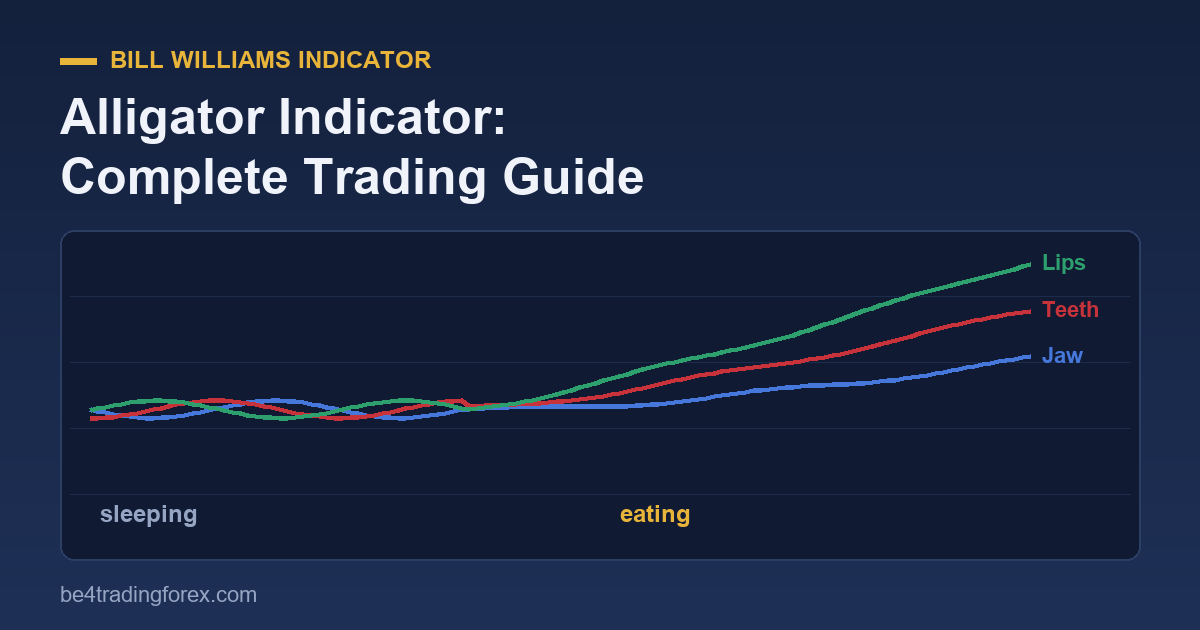
The Alligator indicator, created by trader and author Bill Williams, is built on a simple observation: markets trend only a minority of the time and spend the rest moving sideways. The Alligator’s job is to tell you which phase you are in, so you stay out while the market is “sleeping” and trade when it wakes up and starts “eating”. It is a built-in indicator in MetaTrader 4 and 5, easy to read at a glance, and especially useful for avoiding choppy, sideways markets. This guide explains how it is built, how to read its signals, and three practical ways to trade it.
What Is the Alligator Indicator?
Bill Williams introduced the Alligator in his book Trading Chaos (see our article on signals from Trading Chaos). It consists of three smoothed moving averages, each shifted forward in time, which Williams named after an alligator’s mouth:
| Line | Colour in MT4 | Calculation | Shifted forward |
|---|---|---|---|
| Jaw | Blue | 13-period smoothed moving average of the median price | 8 bars |
| Teeth | Red | 8-period smoothed moving average of the median price | 5 bars |
| Lips | Green | 5-period smoothed moving average of the median price | 3 bars |
The median price is (High + Low) ÷ 2. The forward shift projects each line into the future, which smooths out noise and makes the lines separate only when a real trend is underway. Williams’s numbers (13, 8, 5 and 8, 5, 3) are Fibonacci numbers, a nod to his interest in natural market rhythms.
How to Add the Alligator in MT4
- Open a chart and go to Insert → Indicators → Bill Williams → Alligator.
- Keep the default settings (Jaw 13/8, Teeth 8/5, Lips 5/3, smoothed method, median price) to start.
- Click OK. The three lines appear directly on the price chart.
Reading the Alligator: Four Phases
1. Sleeping
The three lines are close together, intertwined and running flat. The market is ranging with no clear direction. Williams’s advice: do not trade. The longer the Alligator sleeps, the hungrier it gets, so a long sleeping phase often comes before a strong move.
2. Awakening
The lines start to separate and cross. The green Lips usually move first, followed by the red Teeth, then the blue Jaw. This is the early warning that a trend may be starting.
3. Eating
The lines fan out in order and point in the same direction:
- Uptrend: green Lips on top, red Teeth in the middle, blue Jaw at the bottom, all rising, with price above them.
- Downtrend: the order reverses: blue Jaw on top, red Teeth, green Lips at the bottom, all falling, with price below them.
This is the phase to be in a trade. The wider the gap between the lines, the stronger the trend.
4. Sated
The lines start to converge again and flatten. The trend is losing strength, so it is time to take profit or tighten your stop before the Alligator goes back to sleep.
Strategy 1: Basic Alligator Trend Trade
- Wait for the lines to separate after a sleeping phase.
- Buy when the lines are in bullish order (green above red above blue), sloping up, and a candle closes above all three lines. Sell on the reverse.
- Stop loss beyond the blue Jaw, or beyond the recent swing point.
- Exit when price closes back through the red Teeth (aggressive) or the blue Jaw (patient), or when the lines intertwine again.
Using the Teeth or Jaw as an exit works like a built-in trailing stop. For more on trailing exits, see how to set a trailing stop in MT4.
Strategy 2: Alligator + Fractals (Bill Williams’ Method)
Williams paired the Alligator with his Fractals indicator (Insert → Indicators → Bill Williams → Fractals). A fractal marks a small turning point: an up fractal is a high with two lower highs on each side; a down fractal is the mirror image.
- Buy signal: an up fractal forms above the red Teeth, and price breaks above that fractal’s high.
- Sell signal: a down fractal forms below the red Teeth, and price breaks below that fractal’s low.
- Ignore fractals that form inside the Alligator’s mouth: they are just noise inside a range.
Placing a buy stop order just above the qualifying fractal means you only enter if the market proves the breakout.
Strategy 3: Alligator + Awesome Oscillator
The Awesome Oscillator (AO), also from Williams, compares 5-period and 34-period momentum. It confirms whether the Alligator’s trend has momentum behind it:
- Take long Alligator signals only when the AO is above zero (green bars), and short signals only when it is below zero.
- A saucer or zero-line cross on the AO in the trend direction can be used as an extra entry while the Alligator is eating.
- Divergence between price and the AO while the Alligator is sated warns that the trend is ending.
Best Timeframes and Pairs
- Timeframes: the Alligator works best on H1, H4 and daily charts. On M1 to M5 it flips often and produces many false awakenings.
- Pairs: trending pairs and crosses such as GBP/JPY, EUR/JPY, AUD/JPY and gold respond well. Tight-range pairs during the Asian session tend to keep the Alligator asleep.
- Combine with a higher-timeframe filter: trade H1 signals only in the direction of the H4 or daily Alligator.
Alligator vs Moving Average Crossovers
The Alligator is essentially a three-line moving average system, but the forward shift and smoothing make it slower to react and less prone to whipsaws than plain crossovers. The trade-off is later entries. If you already use moving averages, think of the Alligator as a filter that tells you when crossovers are worth taking.
Common Alligator Mistakes
- Trading while it sleeps. The whole point of the indicator is to keep you out of ranges.
- Entering on the first cross. Wait for the lines to separate in the correct order, not just for one line to cross another.
- Using it on very low timeframes. Noise produces constant false awakenings.
- Changing the settings constantly. The defaults are well tested; tweaking them to fit past charts usually makes results worse.
Watch: The Alligator Indicator
See it on a live chart in our videos: The Alligator indicator and Forex: the Alligator indicator.
Frequently Asked Questions
What are the best Alligator indicator settings?
The defaults: Jaw 13 shifted 8, Teeth 8 shifted 5, Lips 5 shifted 3, smoothed moving average of the median price. Most traders keep them unchanged.
Is the Alligator a leading or lagging indicator?
It is lagging, because it is based on moving averages. Its strength is filtering out ranges, not predicting turns.
Which indicators work well with the Alligator?
Bill Williams’ Fractals and Awesome Oscillator are the classic pairing. An oscillator such as the RSI can also help time entries during pullbacks.
Can the Alligator be used for scalping?
It can on M15 with a higher-timeframe filter, but expect more false signals than on H1 and above.
Trading forex on margin carries a high level of risk and may not be suitable for all investors. This guide is educational and is not financial advice.
Keep learning