Martingale Strategy in Forex: How It Works and Why It Blows Accounts
The martingale strategy promises something every trader wants: a system that never loses. The rule is simple. After every losing trade you double your position size, so the first winner recovers all previous losses plus a small profit. On a demo account it can look brilliant for weeks. Then one losing streak wipes out the whole account. This guide explains exactly how martingale works in forex, shows with real numbers why it fails, and covers the safer variations traders use instead.
What Is the Martingale Strategy?
Martingale comes from 18th-century French gambling. A player betting on a coin flip doubles the stake after every loss. Because the coin must land on the winning side eventually, the first win recovers every previous loss and gains the original stake. In theory, with unlimited money and no table limit, you can never lose.
In forex, the same logic becomes:
- Open a trade with a small size, for example 0.01 lots, with equal stop loss and take profit (say 20 pips each).
- If it wins, bank the profit and start again at 0.01 lots.
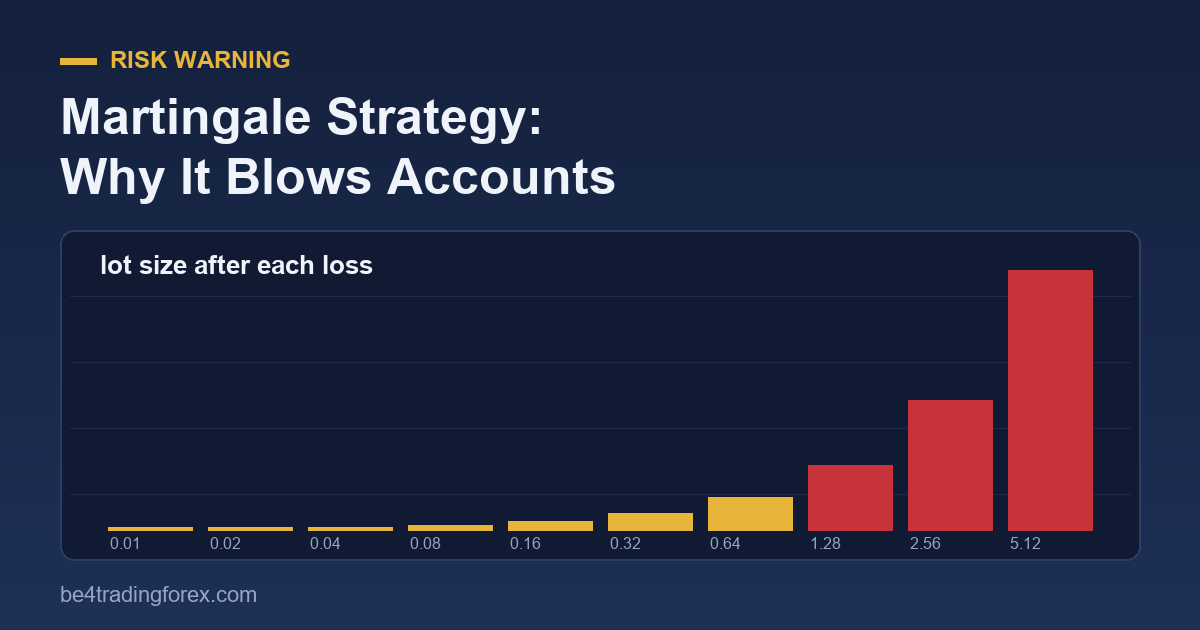
- If it loses, open the next trade at double the size: 0.02 lots, then 0.04, 0.08, and so on.
- When a trade finally wins, you recover all losses plus the profit of the first trade, then reset.
The Numbers: How Fast Martingale Grows
Here is a martingale sequence on EUR/USD with 20-pip stops and targets, starting at 0.01 lots (about $0.10 per pip):
| Trade | Lot size | Risk on this trade | Total lost if this trade also loses |
|---|---|---|---|
| 1 | 0.01 | $2 | $2 |
| 2 | 0.02 | $4 | $6 |
| 3 | 0.04 | $8 | $14 |
| 4 | 0.08 | $16 | $30 |
| 5 | 0.16 | $32 | $62 |
| 6 | 0.32 | $64 | $126 |
| 7 | 0.64 | $128 | $254 |
| 8 | 1.28 | $256 | $510 |
| 9 | 2.56 | $512 | $1,022 |
| 10 | 5.12 | $1,024 | $2,046 |
Notice the trap. The goal of every sequence is to win $2, yet by trade 10 you are risking $1,024 on a single trade after already losing $1,022. That is risking about 500 times your target to recover a run of bad luck.
“But 10 Losses in a Row Never Happens”
It happens far more often than intuition suggests. With a 50% win rate, the chance of 10 losses in a row in any particular sequence is 1 in 1,024. That sounds rare, but an active trader opening 20 trades a day runs through hundreds of sequences a month. Over a year, a 10-loss streak is close to certain.
And forex is worse than a coin flip, for three reasons:
- The spread. With equal 20-pip stops and targets, the spread means price has to move further to hit your target than your stop. Your real win rate is below 50%.
- Trends. Coin flips are independent; markets are not. If you keep buying a pair that is trending down, losses cluster. A strong trend can produce 10, 15 or 20 losses in a row.
- Margin limits. Long before you reach trade 15, your broker will refuse the order or issue a margin call. Unlike the theory, your money is not unlimited.
Why Martingale Looks So Good in Backtests
A martingale equity curve rises in a smooth, steady line, often for months. Each sequence ends in a small win, so the win rate looks like 95% or more. Then a single bad sequence destroys months of gains in a day. This is called negative skew: many small wins, rare catastrophic losses. Short backtests and demo runs rarely include the bad streak, which is why martingale EAs (expert advisors) sell so well and blow up so often. If you test one, run it over many years of data, including fast trending periods like 2008, 2015 (the Swiss franc shock) and 2022.
Martingale Grid EAs
Many “never lose” robots combine martingale with a grid: instead of using stop losses, they open additional, larger positions every X pips against the trade and close everything at a small combined profit when price retraces. The risk is the same, hidden behind floating losses. If price never comes back, the drawdown keeps growing until a margin call closes everything at the worst price. Be very wary of any EA that does not use a stop loss and shows “99% win rate” results.
Safer Alternatives to Martingale
Anti-martingale (pyramiding)
The reverse approach: increase size after wins, reduce it after losses. You add to positions that are already working and cut back when you are wrong. Losses stay small and controlled; the big wins come from strong trends. This is how many professional trend followers manage size, and it pairs well with trailing stops.
Fixed fractional position sizing
Risk the same small percentage of your account on every trade, typically 0.5 to 2%. Position size changes with your stop distance and account balance, never with your last result. Our ATR position-sizing guide shows the exact formula with worked numbers.
Limited martingale (if you must)
Some traders cap martingale at two or three steps and accept a full loss after that. That limits the damage, but it also removes the “never lose” appeal. Once capped, it is just a more volatile form of normal trading. If you experiment with it, do so on a demo account and treat the maximum sequence loss as your real risk per trade.
Martingale vs Normal Risk Management
| Martingale | Fixed fractional (1% per trade) | |
|---|---|---|
| Win rate | Very high (most sequences win) | Depends on strategy |
| Average win | Tiny | Planned (for example 2× the risk) |
| Worst case | Account wiped out | Drawdown from a losing streak, recoverable |
| 10 losses in a row | Lose about 1,000× the target | Lose about 10% of the account |
| Long-term survival | Very poor | Good, if the strategy has an edge |
The Psychology Behind Martingale’s Appeal
Martingale feels right because it removes the pain of being wrong: every losing trade is just a step towards a “guaranteed” win. That is the same mindset as revenge trading, refusing to accept a loss and betting bigger to win it back. Learning to take small, planned losses is one of the core skills covered in the psychology of forex trading and in common forex trading mistakes and traps.
Watch: The Martingale Strategy
For a visual walkthrough, see our video on the forex martingale strategy.
Frequently Asked Questions
Does the martingale strategy work in forex?
It produces frequent small wins, but over time a long losing streak or strong trend almost always wipes out the account. It does not create a real edge; it only changes when you lose.
Is martingale allowed by brokers?
Most brokers allow it, but margin requirements and maximum lot sizes cap how far the doubling can go, which is exactly where the strategy breaks.
What is the difference between martingale and anti-martingale?
Martingale increases size after losses; anti-martingale increases size after wins. Anti-martingale keeps losses small and lets winning streaks grow, which is far more robust.
Are martingale EAs safe?
Treat any EA that doubles after losses or trades without a stop loss as very high risk, however good its recent results look. Test it over many years of data and only risk money you can afford to lose.
Trading forex on margin carries a high level of risk and may not be suitable for all investors. This guide is educational and is not financial advice.
Keep learning