Forex Spreads Explained: What a Spread Costs You and Why It Widens (US Brokers)
The spread is the gap between the bid price (where you can sell) and the ask price (where you can buy). It is the main cost of most forex trades: you open every position at a small loss equal to the spread. On EUR/USD, a 1-pip spread costs $10 per standard lot, $1 per mini lot and $0.10 per micro lot. Spreads are tightest on major pairs during busy hours and widen around the 5 PM ET rollover, before and after big news, and on holidays.
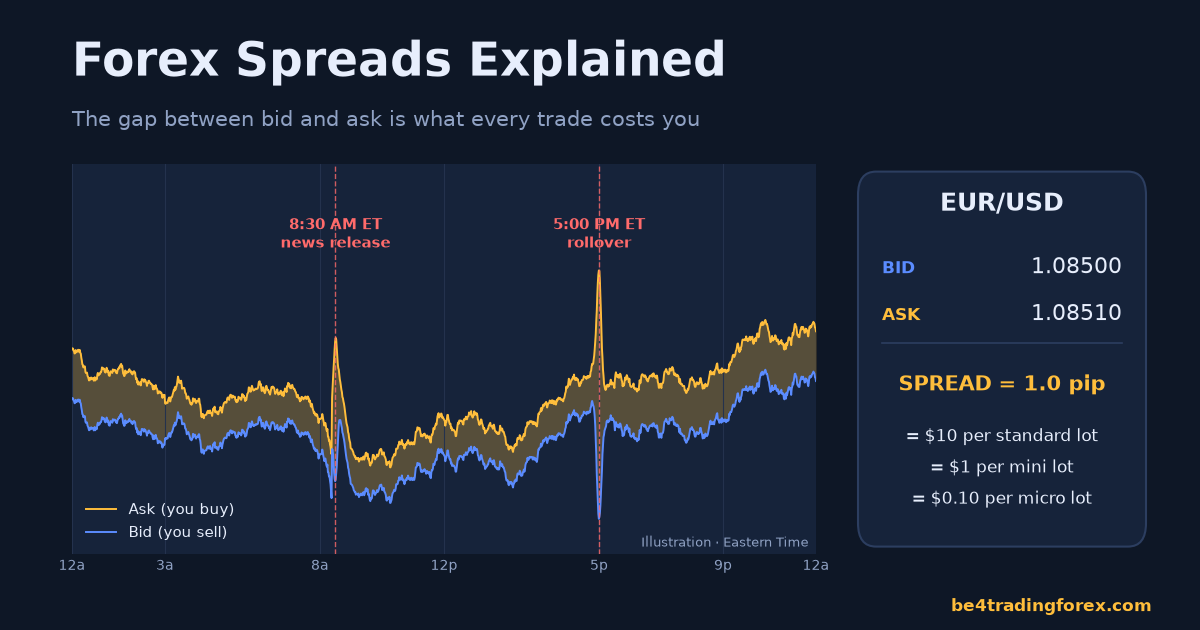
This guide shows how to read a spread, convert it into dollars, see why it changes during the day, and keep it from eating your profits. All examples assume a US account in USD.
Bid, Ask and Spread in One Example
A broker quotes two prices for every pair. Suppose EUR/USD shows:
| Price | Value | What it means |
|---|---|---|
| Bid | 1.08500 | The price you get when you sell |
| Ask | 1.08510 | The price you pay when you buy |
| Spread | 0.00010 = 1.0 pip | Ask minus bid, your cost to enter and exit |
If you buy at 1.08510 and sell straight back, you get 1.08500 and lose 1 pip. That is why a new position always starts slightly negative. Many platforms quote a fifth decimal (a “pipette”), so a spread shown as “10 points” in MetaTrader is 1.0 pip. If pips and lots are new to you, start with the forex glossary and what forex trading is.
How to Convert a Spread into Dollars
Spread cost = spread in pips × pip value × number of lots. You pay it once per round trip: you buy at the ask and later sell at the bid, or the other way around.
| Example | Spread | Pip value (1 standard lot) | Cost per standard lot | Per micro lot |
|---|---|---|---|---|
| EUR/USD | 1.0 pip | $10.00 | $10.00 | $0.10 |
| GBP/USD | 1.5 pips | $10.00 | $15.00 | $0.15 |
| USD/JPY at 150.00 | 1.5 pips | about $6.67 | about $10.00 | about $0.10 |
| USD/MXN at 18.50 | 30 pips | about $0.54 | about $16.20 | about $0.16 |
The spreads in this table are examples to show the math, not quotes from a specific broker. Note the last row: 30 pips on USD/MXN sounds huge, but because its pip is worth much less, the dollar cost is closer to a major pair’s than the pip count suggests. Compare costs in dollars, not pips. The pip value calculator gives the pip value for any pair and lot size, and the profit and loss calculator shows a trade’s result after the spread.
Why Spreads Widen
A spread reflects how easily the dealer can offset your trade. When fewer banks are quoting, or prices are jumping, the spread grows. The most common moments:
- The 5 PM ET rollover. New York closes and the trading day rolls over. Liquidity is thin for a short period, and spreads often widen sharply for a few minutes. The same happens at the Sunday open around 5 PM ET.
- Major news. US data such as payrolls and CPI is usually released at 8:30 AM ET, and Federal Reserve decisions come out in the afternoon. Spreads can widen in the minutes before and after the release. See how economic data moves currencies.
- Quiet sessions. EUR/USD and GBP/USD are cheapest during the London–New York overlap, 8 AM to 12 PM ET, and usually wider in the late US afternoon and the Asian session. The market hours guide explains each session.
- Holidays. When London or New York is closed, fewer banks quote prices. Check the forex holiday calendar.
- Exotic and minor pairs. Less trading means wider spreads all day. That is one reason the best pairs for beginners are the majors.
Fixed, Variable and Commission Accounts
| Account type | How you pay | Good to know |
|---|---|---|
| Variable (floating) spread | Spread only; it moves with the market | Tight in busy hours, wide around news and rollover |
| Fixed spread | The same quoted spread most of the time | Usually a little wider on average; fills can still change in fast markets |
| Raw spread + commission | A very small spread plus a commission per lot | Add both: for example, $5 per side per standard lot is $10 round trip, the same as 1 pip on EUR/USD |
The cheapest choice depends on how you trade. Frequent traders feel every fraction of a pip; someone holding trades for days cares more about overnight financing.
How the Spread Affects Your Trades
Short-term trading pays the most
If your target is 5 pips and the spread is 1 pip, the spread takes 20% of the target. On a 100-pip swing trade, the same spread is 1%. That is why scalping strategies only work on the tightest pairs and hours.
Sell stops are triggered by the ask
MetaTrader charts show the bid by default. Buy positions close at the bid, but sell positions close at the ask. If the spread jumps at 5 PM ET, a short position’s stop loss can be hit even though the bid line on your chart never reached it. To see this, open chart properties (F8) and turn on “Show Ask price line” (MT4: “Show Ask line”), and in Market Watch right-click and add the Spread column.
Size from the real stop
Include the spread in your stop distance when you size the trade. The position size calculator turns your stop and risk into lots.
Spreads at US Brokers
A US retail forex dealer is usually your counterparty, and it earns money from the spread, commissions or both. NFA rules require Forex Dealer Members to disclose their costs, and many publish average spreads and cost-per-trade figures on their websites. NFA also treats slippage settings that favor the dealer over the customer as a violation of its rules. Before opening an account, confirm the firm is registered using the US broker checklist, and see the US forex trading rules for leverage limits and FIFO.
5 Ways to Pay Less Spread
- Trade the majors, EUR/USD first.
- Trade the busy hours, ideally 8 AM to 12 PM ET.
- Avoid 4:50 to 5:15 PM ET and the minutes around major data releases unless your plan is built for them.
- Trade less often. Fewer, better trades mean fewer spreads paid.
- Compare in dollars per round trip, including commission, for the pair and lot size you actually trade.
Frequently Asked Questions
What is a good spread for EUR/USD?
For a retail account, around 1 pip or less in busy hours is generally considered tight, though it varies by broker, account type and time of day. Check the broker’s published spread data rather than a single screenshot of a quiet moment.
Do I pay the spread twice?
No. You pay it once per round trip: the entry price and the exit price are on opposite sides of the quote. Commission accounts usually charge commission on both the opening and the closing trade.
Why did my stop loss trigger when the chart did not touch it?
For a sell position, the stop is triggered by the ask, but the chart shows the bid. A spread spike, often at the 5 PM ET rollover or during news, can reach the stop. Turn on the ask line to see it.
Is a zero-spread account free?
Not usually. The cost is normally charged as a commission or built into other fees. Add up the total cost per trade before choosing.
Does the spread affect swing traders?
Less than scalpers, because it is small compared with a large target. Swing traders also pay overnight financing (swap), which can matter more over many days.
General education, not financial advice. Forex trading involves substantial risk of loss and is not suitable for everyone. Only trade money you can afford to lose.
Sources
- CFTC, Customer Advisory: Eight Things You Should Know Before Trading Forex: dealers as counterparties, and fees, spreads and commissions.
- National Futures Association, Compliance Rule 2-36 : forex dealers must disclose per-trade costs, including commissions, mark-ups and spread costs.
- National Futures Association, Interpretive Notice on forex price changes (2011): asymmetrical slippage that favors the dealer violates Rule 2-36.
- National Futures Association, BASIC search for checking a dealer’s registration.
- CFTC regulations, 17 CFR Part 5: off-exchange retail forex transactions.
Keep learning