How Much Does Forex Move on NFP Day? We Measured 55 Jobs Reports (Data Study)
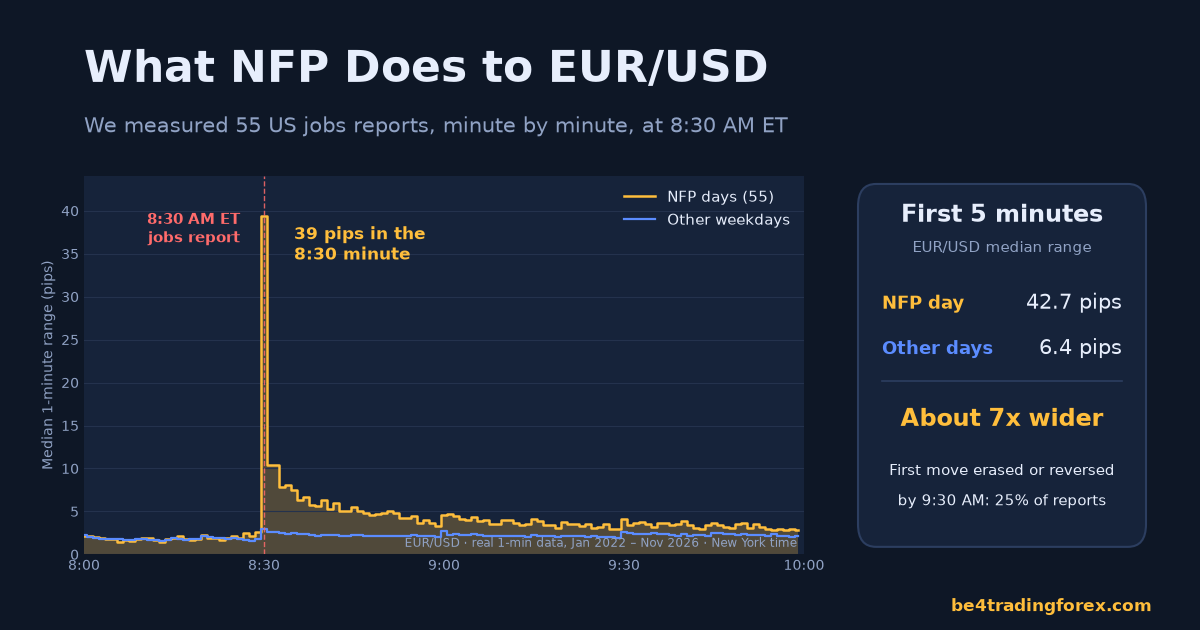
The US jobs report (NFP) makes the 8:30 AM ET minute the most violent of the month. We measured 55 releases from January 2022 to November 2026 with 1-minute data: EUR/USD’s median range in the first five minutes was 42.7 pips, about 6.7 times a normal weekday at the same time (6.4 pips). GBP/USD and USD/JPY behaved the same way. The first move was erased or reversed by 9:30 AM in about one report in four.
Our NFP guide explains what the Employment Situation report is and why it moves the dollar. This study answers the practical questions: how far do prices actually move, how fast, for how long, and how often does the first move hold? How we measured is at the end.
Results: How Much the Majors Move After NFP
Median values over 55 NFP releases, in pips. “Normal days” are all other weekdays (Monday to Friday) at the same time of day.
| Measure (New York time) | EUR/USD | GBP/USD | USD/JPY |
|---|---|---|---|
| Range of the 8:30 minute alone | 39.4 | 45.4 | 57.4 |
| Range, 8:30 – 8:35 AM (NFP day) | 42.7 | 49.7 | 63.1 |
| Range, 8:30 – 8:35 AM (normal days) | 6.4 | 8.0 | 9.8 |
| Range, 8:30 – 9:30 AM (NFP day) | 53.7 | 62.5 | 82.9 |
| Range, 8:30 – 9:30 AM (normal days) | 20.1 | 24.5 | 28.9 |
| Net move after 5 minutes (either direction) | 24.5 | 22.8 | 31.6 |
| Net move after 1 hour (either direction) | 26.1 | 28.8 | 37.2 |
| 1-hour range on the busiest 10% of reports | 90+ | 107+ | 180+ |
Four things stand out:
- Almost all of the action is in the first minute. The 8:30 minute alone covers most of the first five minutes’ range. On EUR/USD the median 1-minute range jumps from 2.6 pips at 8:29 to 39.4 pips at 8:30, then drops to about 10 pips at 8:31 and keeps fading.
- The first five minutes are about 6 to 7 times wider than normal on all three pairs (6.7x EUR/USD, 6.2x GBP/USD, 6.4x USD/JPY). Over the full hour the gap narrows to about 2.6 to 2.9 times, because the market calms down after the release.
- Most of the net move is done in five minutes. EUR/USD’s median net move was 24.5 pips after 5 minutes and 26.1 pips after an hour: the hour adds a lot of back-and-forth, not much extra distance.
- It is the report, not the Friday. On ordinary Fridays the 8:30–8:35 range was 6.3 pips on EUR/USD, the same as any other weekday.
Does the First Move Hold?
We compared the direction of the first five minutes with the price at 9:30 AM, one hour after the release:
| What happened by 9:30 AM | EUR/USD | GBP/USD | USD/JPY |
|---|---|---|---|
| Kept going: same direction, bigger move | 42% | 45% | 47% |
| Held partly: same direction, smaller move | 33% | 31% | 26% |
| Erased or reversed the first move | 25% | 24% | 27% |
So the first move usually points the right way, but one report in four turns it around within the hour, often after traders read the revisions to earlier months, the unemployment rate and wages, not just the headline. Chasing the first spike is a coin toss with very wide spreads.
The dollar also moves as one block. In 47 of 53 releases (89%), EUR/USD, GBP/USD and USD/JPY all agreed in the first five minutes: the dollar either rose against all three or fell against all three. That is why NFP is a dollar-wide event, not a pair-specific one.
The Biggest Reactions in Our Sample
- October 4, 2024 (September report): payrolls rose 254,000, far above forecasts. USD/JPY jumped 177 pips in five minutes and 211 pips within the hour, a 240-pip range: the largest in our data.
- August 1, 2025 (July report): a weak report with large downward revisions to earlier months. EUR/USD rose 114 pips in five minutes and 175 pips within the hour as the dollar fell.
Reactions also change with the year. EUR/USD’s median one-hour range was 51.6 pips in 2022, 47.6 in 2023, 65.8 in 2024, 59.7 in 2025 and 41.3 so far in 2026. Three 2025–2026 reports came out on unusual days because of federal government shutdowns, but still at 8:30 AM ET.
What It Means for Your Trading
- Know the date. NFP is usually the first Friday of the month at 8:30 AM ET, but not always. Check the BLS schedule and our holiday calendar, and convert the time with the market hours clock.
- Tight stops are not safe at 8:30. A median first-minute range of 39 pips on EUR/USD means a 20-pip stop can be hit by the spike alone, even if price ends the hour where it started. See where to place a stop-loss.
- Size down. If you hold a position through NFP, use a smaller lot so that a 50–90 pip swing stays inside your risk limit. The position size calculator does the math; on one standard lot of EUR/USD, a 53.7-pip range is about $537.
- Expect slippage and wide spreads. Stop and pending orders can fill pips away from your price in the first seconds. Our spread study shows how quickly spreads blow out when liquidity thins, and order types explains which orders fill on the bid and which on the ask.
- Watch your margin. With US leverage up to 50:1 on majors, a fast 100-pip move on a large position can push the account toward a margin call.
- Waiting is a strategy. Volatility is still above normal at 9:00 AM ET but far calmer than at 8:30. Many traders let the first 15–30 minutes pass and trade the London–New York overlap afterwards: see the best time to trade forex.
How We Measured
Release dates come from the Bureau of Labor Statistics archive of Employment Situation news releases: 58 releases from January 7, 2022 to November 6, 2026, all published at 8:30 AM ET. Prices are free 1-minute bid bars from HistData.com for EUR/USD, GBP/USD and USD/JPY. The time stamps are New York local time: we checked that the release spike falls exactly at 8:30 in both winter and summer. Three 2023 releases (March 10, April 7 and June 2) had gaps in the data feed and were left out, so the results cover 55 releases. For each release we took the last close before 8:30 as the starting price, then measured the high-to-low range and the net move after 5, 15 and 60 minutes. “Normal days” are every other weekday from 2022 to 2026 in the same 8:30–9:30 window (about 1,150 days per pair); some of them carry smaller releases such as CPI, so the true gap versus a quiet morning is even larger. We report medians so that one extreme report cannot distort the result. Bid-only data from a single feed; your broker’s prices, spreads and fills on NFP will differ.
Frequently Asked Questions
How many pips does EUR/USD move on NFP?
In our data from 2022 to 2026, EUR/USD’s median range was 42.7 pips in the first five minutes after 8:30 AM ET and 53.7 pips in the first hour. On the busiest 10% of reports, the first hour covered 90 pips or more.
Is it a good idea to trade NFP?
It is risky. Spreads widen, orders slip, and the first move was erased or reversed within an hour in about one report in four. Beginners are usually better off staying flat or trading smaller, and practising on a demo account first.
How long does NFP volatility last?
The biggest burst is the 8:30 minute itself. Volatility fades quickly after that but stays above normal for at least an hour: at 9:00 AM ET, EUR/USD’s median 1-minute range was still about 4.6 pips versus 2.7 on other days.
Which pair moves the most on NFP?
In pips, USD/JPY: a median 63.1 pips in the first five minutes, versus 49.7 for GBP/USD and 42.7 for EUR/USD. Relative to its own normal volatility, each pair moved about 6 to 7 times more than usual.
Disclaimer: This study is for educational purposes only and is not financial advice. Past market reactions do not predict future ones. Forex trading carries a high level of risk and may not be suitable for all investors. The CFTC notes that most retail forex customers lose money.
Sources
- U.S. Bureau of Labor Statistics, Employment Situation archived news releases (release dates).
- Data: HistData.com free ASCII 1-minute bars, EUR/USD, GBP/USD and USD/JPY, January 2022 to November 2026, analysed by Be4TradingForex.
- CFTC, Customer Advisory: Eight Things You Should Know Before Trading Forex (PDF).
Free to cite: you may reuse the chart and figures with a link to this page.
Keep learning