What Is Forex Trading? How It Works (Beginner’s Guide)
Forex trading is buying one currency and selling another at the same time, to profit from a change in the exchange rate between them. Traders speculate on pairs such as EUR/USD through a broker, usually with leverage, in a market that is open 24 hours a day from Sunday 5 PM to Friday 5 PM Eastern Time. It is the largest financial market in the world.
Forex meaning: “forex” is short for foreign exchange (also written FX), the global market where one currency is traded for another. It sets the exchange rates used by businesses, travellers, governments and investors. This guide explains, in simple terms, how a forex trade works, how currency pairs and prices are quoted, who trades and why, what moves exchange rates, the costs and risks, and how to start learning safely.
How Forex Trading Works, in Simple Terms
Every forex trade is a bet on one currency against another. If you think the euro will gain value against the US dollar, you buy EUR/USD: you buy euros and sell dollars. If the euro rises, you close the trade by selling the euros back for more dollars than you paid. If you think the euro will fall, you sell EUR/USD instead and profit if it drops.
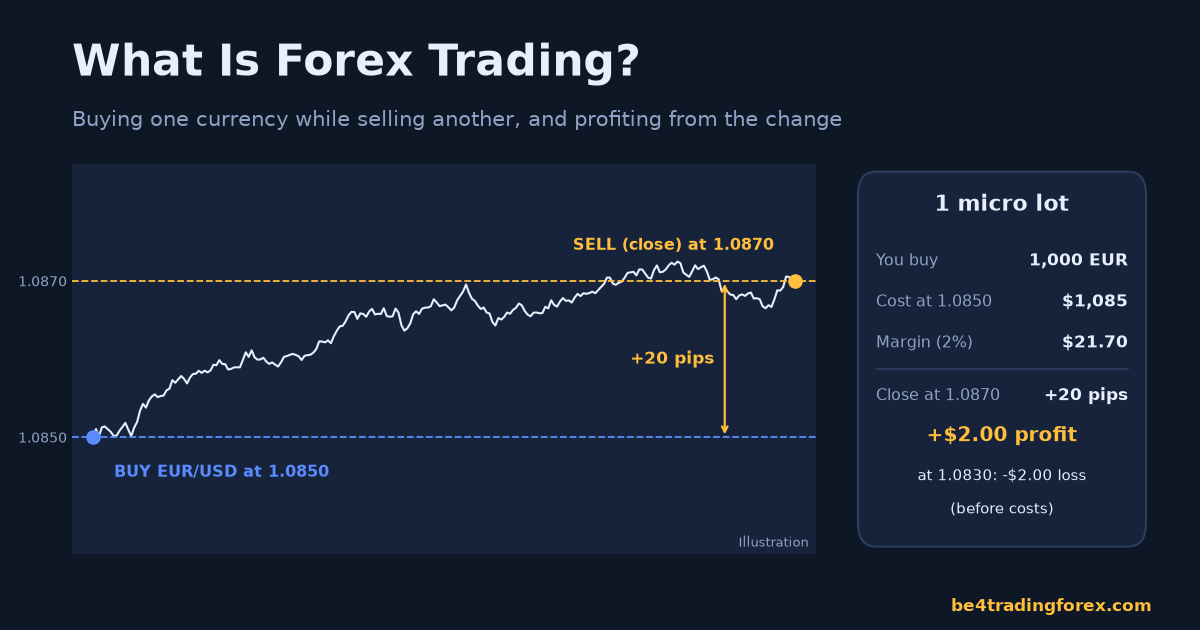
Worked example (US account, in dollars):
- You buy 1 micro lot of EUR/USD (1,000 euros) at 1.0850. The position is worth $1,085.
- Under US rules your broker holds 2% of that as margin: $21.70. See leverage.
- The price rises to 1.0870 and you close: +20 pips × $0.10 per pip = +$2.00 before costs.
- If it had fallen to 1.0830 instead, you would have lost $2.00. Bigger positions scale the same way: a standard lot is 100 times larger.
You never receive the euros. Retail forex is a contract with your broker on the price, settled in your account currency. That is the main difference from exchanging cash at a bank or airport, where you actually receive the other currency to spend.
What Is the Forex Market?
The forex market has no central exchange. It is a network of banks, brokers, companies and investors trading with each other electronically, which is why it is called an over-the-counter (OTC) market. According to the Bank for International Settlements (BIS) Triennial Survey, average daily turnover reached about $9.6 trillion in April 2025, up from about $7.5 trillion in 2022. The US dollar is on one side of almost 9 out of 10 trades.
Most of that volume comes from banks, institutional investors and companies. Retail traders, individuals trading through online brokers, are a small but growing part of the market.
A Short History of the Forex Market
- 1944, Bretton Woods: major currencies were pegged to the US dollar, and the dollar was convertible into gold at $35 an ounce. Exchange rates barely moved.
- 1971-1973: the United States ended dollar convertibility into gold, and the major currencies moved to floating exchange rates. Modern currency trading grew from this point.
- 1990s: electronic trading platforms connected banks worldwide, and online brokers began offering forex to individuals.
- 1999: the euro was launched, replacing the German mark, French franc and other currencies; EUR/USD soon became the most traded pair.
- 2000s to today: platforms such as MetaTrader, mobile trading and regulation of retail brokers made the market accessible to individual traders. In the US, retail forex has been regulated by the CFTC under rules in force since 2010.
Currency Pairs and How to Read a Quote
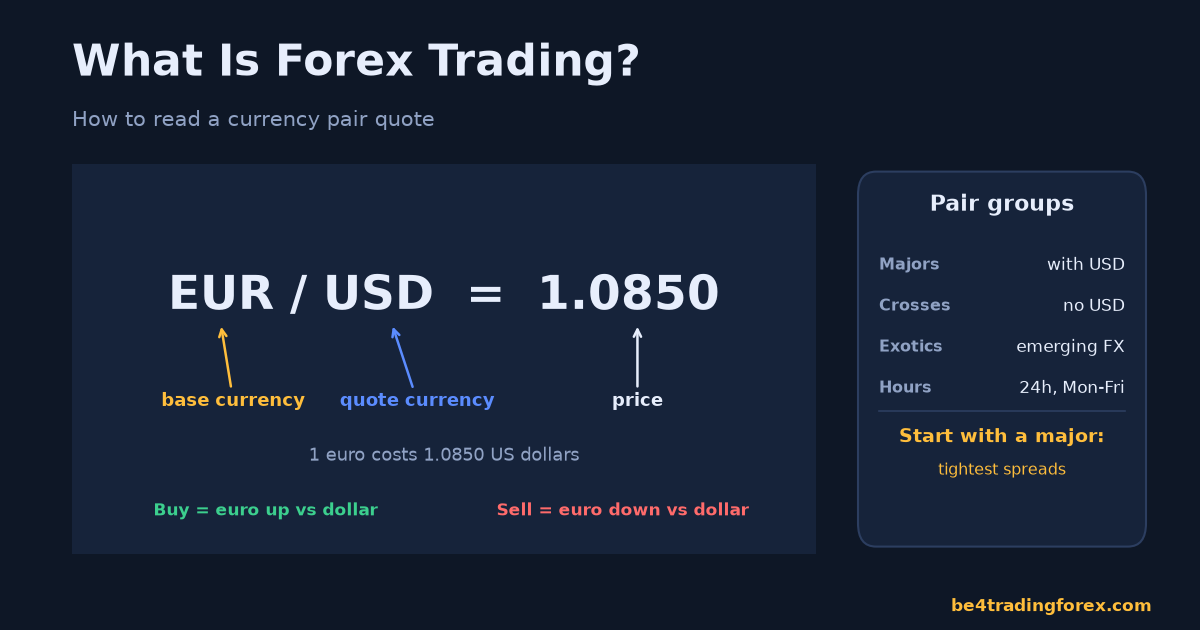
Currencies are always traded in pairs, because buying one currency means selling another. In the quote EUR/USD = 1.0850:
- EUR is the base currency and USD the quote currency.
- The price means 1 euro costs 1.0850 US dollars.
- Buying EUR/USD (going long) means you expect the euro to rise against the dollar; selling (going short) means you expect it to fall.
| Group | Examples | Characteristics |
|---|---|---|
| Major pairs | EUR/USD, USD/JPY, GBP/USD, USD/CHF, AUD/USD, USD/CAD, NZD/USD | Include the US dollar; highest liquidity and tightest spreads |
| Crosses (minors) | EUR/GBP, EUR/JPY, GBP/JPY, AUD/NZD | Two major currencies without the dollar |
| Exotics | USD/MXN, USD/ZAR, USD/TRY, USD/SGD | A major against an emerging-market currency; wider spreads, more volatile |
In the US, the group also sets your minimum margin: 2% (50:1) on pairs built from NFA’s ten listed major currencies and at least 5% (20:1) on the rest. The full list is in currency pairs explained.
Pips, Lots and Spreads
- Pip: the standard unit of price movement, usually the fourth decimal (0.0001) and the second decimal for JPY pairs (0.01). If EUR/USD moves from 1.0850 to 1.0870, it has moved 20 pips.
- Lot: the trade size. A standard lot is 100,000 units of the base currency, a mini lot 10,000 and a micro lot 1,000. On EUR/USD a pip is worth about $10, $1 and $0.10 respectively.
- Bid and ask: you sell at the bid and buy at the higher ask. The difference is the spread, the main trading cost. See forex spreads explained for what a spread costs in dollars and why it widens.
Trading Sessions
| Session | Hours (Eastern Time) | Typical activity |
|---|---|---|
| Sydney | 5:00 PM – 2:00 AM | Quiet; AUD and NZD active |
| Tokyo | 7:00 PM – 4:00 AM* | JPY pairs active; often range-bound |
| London | 3:00 AM – 12:00 PM | The busiest session; large share of daily volume |
| New York | 8:00 AM – 5:00 PM | USD news; the London-New York overlap is the most volatile period |
*Japan has no daylight saving time, so in the US summer Tokyo runs 8:00 PM – 5:00 AM ET; other sessions can shift for a few weeks when the US and Europe change clocks on different dates. London opens around 3 AM ET and New York at 8 AM, and the busiest window is the London–New York overlap from 8 AM to 12 PM ET; see forex market hours in Eastern Time.
Who Trades Forex and Why
- Central banks manage reserves and sometimes intervene to influence their currency.
- Commercial banks trade for clients and their own accounts; they form the core of the market.
- Companies exchange currencies to pay for imports, receive export revenue and hedge future payments.
- Investment funds trade currencies as part of international investing and speculation.
- Retail traders speculate on exchange-rate changes through brokers, usually with leverage.
What Moves Exchange Rates
In the long run, currencies follow interest rates, inflation, growth and the decisions of central banks. In the short run, they react to economic releases, political events and changes in risk sentiment. Our fundamental analysis guide covers these drivers, and the technical analysis guide explains how traders read the charts.
How Retail Forex Trading Works
- You open an account with a broker and deposit money.
- You trade through a platform such as MetaTrader 4 or 5, choosing the pair, the direction and the size.
- Your broker provides leverage, so a small deposit (margin) controls a larger position.
- Your profit or loss is the price change in pips, multiplied by the pip value and the lot size, minus costs.
Example: you buy 0.1 lots of EUR/USD at 1.0850 and close at 1.0880. That is 30 pips at $1 per pip, a $30 profit before costs. Had the price fallen 30 pips instead, you would have lost $30.
Ways to Trade Currencies
| Instrument | How it works | Who uses it |
|---|---|---|
| Spot forex | Trade the exchange rate with a broker, with leverage; no delivery of currency. (CFDs on currencies are not available to US residents.) | Most retail traders |
| Currency futures | Standardised contracts on an exchange such as the CME, with a fixed expiry | Institutions, some active traders |
| Forwards | Private agreements to exchange currency at a set rate on a future date | Companies hedging payments |
| Options | The right, not the obligation, to exchange at a set rate | Hedgers and experienced traders |
| Currency ETFs | Exchange-traded funds tracking a currency or basket | Investors without leverage |
Key Forex Terms
| Term | Meaning |
|---|---|
| Long / short | Buying (expecting a rise) / selling (expecting a fall) |
| Margin | The deposit needed to open a leveraged position |
| Stop-loss | An order that closes a trade at a set loss |
| Take-profit | An order that closes a trade at a set profit |
| Swap / rollover | Interest paid or received for holding a position overnight; see swap and rollover |
| Volatility | How much and how quickly price moves; see our ATR guide |
| Liquidity | How easily a pair can be traded without moving the price |
Costs and Risks
- Spreads and commissions on every trade.
- Swaps, the overnight interest charged or paid on positions held past the daily rollover.
- Leverage risk: losses are calculated on the full position, so they can be large relative to the deposit.
- Broker risk: unregulated brokers may not protect client funds. In the US, check that the firm is registered with the CFTC and is an NFA member in NFA BASIC (see the broker verification checklist); offshore firms may not solicit US residents.
US forex dealers must publish, every quarter, the share of their retail accounts that were profitable, and those figures typically show that most retail accounts lose money (see what US broker data says). Forex trading can be learned, but most beginners lose money at first.
How to Start Learning Safely
Our step-by-step guide to starting forex trading covers each of these steps in detail, with US rules and a worked example.
- Learn the basics: pairs, pips, lots, leverage and the main order types.
- Open a free demo account and practise on MetaTrader with virtual money.
- Learn risk management before strategies: position sizing, stop-losses, the 1% rule.
- Choose one simple strategy and test it on demo for at least a few months.
- If you go live, start small with money you can afford to lose, with a CFTC-registered, NFA-member broker.
Watch: What Is Forex? (Video)
A short video introduction to the forex market:
What is the spread in forex?:
Forex market hours and sessions:
How do forex traders make money?:
Related reading: New to the vocabulary and mechanics? Continue with forex trading terminology glossary, forex order types and how to calculate profit and loss and line, bar and candlestick charts explained.
Related reading: For US traders, see forex market hours in Eastern Time and US forex rules (CFTC/NFA leverage limits, FIFO and hedging).
Ready to test yourself? Try our free forex quiz: 30 questions in three levels.
Sources and Further Reading
- Kathy Lien, Day Trading and Swing Trading the Currency Market (3rd ed., 2015).
- Bank for International Settlements, Triennial Central Bank Survey 2025 (daily FX turnover).
- CFTC, Eight Things You Should Know Before Trading Forex.
- CFTC regulations, 17 CFR Part 5: retail forex rules, including security deposits.
- National Futures Association, BASIC registration search.
Forex Basics FAQ
What does forex mean?
Forex is short for foreign exchange (FX): the market where currencies are exchanged and exchange rates are set. “Forex trading” means buying one currency and selling another to profit from changes in their exchange rate.
What is forex trading in simple terms?
It is exchanging one currency for another to profit from a change in the exchange rate. You buy a pair such as EUR/USD if you expect the first currency to rise against the second, and sell it if you expect it to fall.
How does forex trading work?
You open an account with a regulated broker, choose a pair, a direction and a size on a trading platform, and the broker holds a small deposit (margin) while the trade is open. Your profit or loss is the price change in pips times the pip value, minus costs such as the spread.
Is forex trading the same as currency exchange?
No. Exchanging money at a bank gives you the other currency to spend. Retail forex trading is a contract on the price: you never receive the currency, and gains or losses are settled in your account.
Can beginners trade forex?
Yes, but most beginners lose money at first. Start on a free demo account, learn risk management and follow a step-by-step plan before trading small amounts of real money.
How much money do I need to start forex trading?
Many brokers accept small deposits, and micro lots let you trade with very little money. It is wiser to practise on a free demo account first and only risk money you can afford to lose.
Is forex trading legal?
Yes. In the US, retail forex is legal and regulated by the CFTC and the NFA; trade only with a firm registered as a retail foreign exchange dealer or futures commission merchant that is an NFA member. Rules differ in other countries.
Can you get rich from forex trading?
A small minority of traders are consistently profitable. Most retail accounts lose money, so treat forex as a skill that takes time to learn, not a quick way to make money.
When is the forex market open?
From Sunday 5 PM to Friday 5 PM Eastern Time (ET), 24 hours a day, as trading moves from Sydney to Tokyo, London and New York.
Keep learning