Carry Trade in Forex: How It Works and Why It Crashes (2008 and 2024)
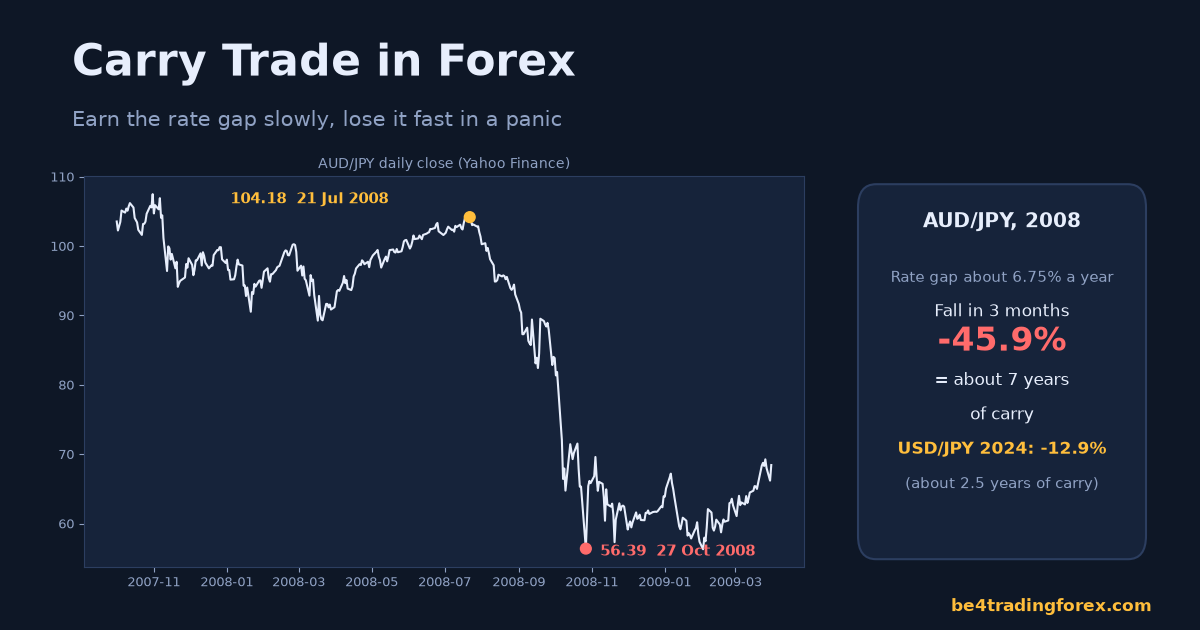
A carry trade means buying a currency with a high interest rate against one with a low rate, and earning the difference every day you hold the position, through the daily swap. It pays slowly and steadily while markets are calm, but carry currencies tend to fall sharply when investors get scared, and that fall can wipe out years of interest in weeks. In July to October 2008, AUD/JPY fell 45.9%, about seven years of its interest-rate gap at the time; in July to September 2024, USD/JPY fell 12.9% from its peak, more than two years of carry. A carry trade is a bet on calm markets, not free money.
How a Carry Trade Works
- Find a rate gap. For example, a US short-term rate around 5.3% against a Japanese rate near 0% (the situation in mid-2024).
- Buy the high-yielding currency against the low-yielding one: here, buy USD/JPY.
- Collect the interest difference as a positive swap each night the position is held over the 5 PM ET rollover, with three days credited on Wednesdays. See forex swap and rollover.
- Hope the exchange rate stays stable or rises. The interest is small; the exchange-rate move is what makes or breaks the trade.
A retail broker usually credits less than the full rate difference and charges more than the full difference on the other side, so the swap you see is smaller than the headline gap. Check your platform’s swap table before trading carry.
Classic Carry Pairs
| Pair | Typical idea | Main risk |
|---|---|---|
| AUD/JPY, NZD/JPY | Higher Australian or New Zealand rates vs near-zero yen rates | Sharp falls in risk-off episodes |
| USD/JPY | US rates far above Japanese rates (2022-2024) | Changes in Fed or Bank of Japan policy |
| Emerging-market pairs (for example USD/MXN short) | Much higher local rates | Wide spreads, political and currency-crisis risk |
The yen and the Swiss franc are usually the funding side because their rates have been the lowest and because they tend to rise when markets panic; see safe haven currencies.
What the Data Shows: Two Carry Unwinds
We measured the exchange-rate side with Yahoo Finance daily closes and compared it with the central-bank rate gap at the time.
| Episode | Rate gap at the peak | Peak | Low | Fall | Years of carry lost |
|---|---|---|---|---|---|
| AUD/JPY, 2008 | About 6.75% a year (RBA 7.25% vs BOJ 0.5%) | 104.18 on 21 Jul 2008 | 56.39 on 27 Oct 2008 | −45.9% | About 7 |
| USD/JPY, 2024 | About 5.2% a year (Fed 5.25-5.50% vs BOJ 0-0.25%) | 161.62 on 3 Jul 2024 | 140.79 on 15 Sep 2024 | −12.9% | About 2.5 |
- 2008: during the global financial crisis, investors closed carry trades all at once. AUD/JPY lost almost half its value in about three months.
- 2024: after the Bank of Japan raised rates on 31 July 2024 and US data weakened, the yen carry trade unwound; global markets fell sharply on 5 August 2024. USD/JPY had risen from 115.14 at the start of 2022 to 161.62, then gave back almost half of that rise by mid-September.
- The pattern: carry earns a few percent a year in calm markets and can lose many years of that in weeks. In the language of risk-on and risk-off, carry is a risk-on trade.
Leverage Makes Both Sides Bigger
With 10:1 leverage, a 5% rate gap becomes about 50% a year on your margin, before costs. The same leverage turns a 12.9% fall into a loss of about 129% of the margin: more than the account. That is why US rules cap leverage at 50:1 on majors and 20:1 on other pairs (see US forex rules), and why a margin call is the usual end of an over-leveraged carry trade.
How to Manage Carry Trade Risk
- Use low leverage. Size so that a 15% to 20% move against you is survivable.
- Use a stop loss based on the exchange rate, not on the interest earned so far.
- Watch central banks. Rate decisions and guidance from the Fed, the BOJ and the RBA change the carry and often the trend; check the economic calendar.
- Watch risk sentiment. Falling stock markets and a rising yen are early warning signs; see forex market sentiment.
- Know your real swap. Compare the swap your broker pays with the headline rate gap.
Frequently Asked Questions
Is the carry trade still profitable?
It can be when there is a large rate gap and markets are calm, as USD/JPY was from 2022 to mid-2024. But the 2024 unwind showed how quickly the gains can disappear.
How is carry paid in forex?
Through the daily swap (rollover) when you hold a position past 5 PM ET. A positive swap is added to your account; a negative swap is charged.
What is a carry trade unwind?
When many traders close carry trades at the same time, usually in a market panic, they sell the high-yielding currency and buy back the funding currency, which makes the move even sharper.
Why is the yen used for carry trades?
Japanese interest rates were near or below zero for many years, so borrowing in yen was cheap. The yen also tends to strengthen in a crisis, which is what makes yen carry trades fall so fast.
Is the carry trade the same as interest rate arbitrage?
No. Arbitrage tries to lock in a risk-free profit; a carry trade is exposed to the exchange rate. See forex arbitrage explained.
General education, not financial advice. Forex trading involves substantial risk of loss and is not suitable for everyone. Past exchange-rate moves and interest-rate differences do not guarantee future results. Only trade money you can afford to lose.
Sources
- Yahoo Finance daily closes for AUDJPY=X and USDJPY=X (our calculations).
- Board of Governors of the Federal Reserve System, Open market operations: policy rate history.
- Reserve Bank of Australia, Cash rate target history.
- Bank of Japan, monetary policy statements of 19 March 2024 and 31 July 2024.
Keep learning