Kelly Criterion in Forex: How Much to Risk per Trade (Simulation)
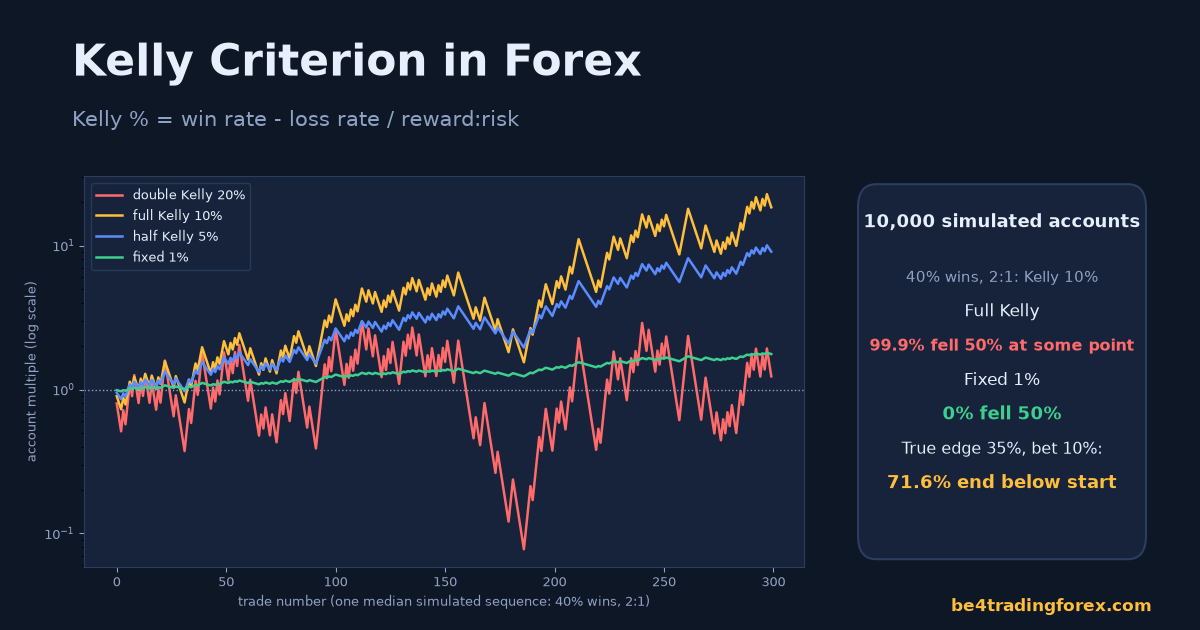
The Kelly criterion is a formula for the share of your account to risk on each trade so that the account grows as fast as possible over the long run: Kelly % = win rate − (loss rate ÷ reward-to-risk ratio). A strategy that wins 40% of the time with 2:1 trades has a Kelly fraction of 10%. In our simulation of 10,000 accounts over 300 such trades, full Kelly had the highest median growth but 99.9% of accounts fell 50% from a peak at some point; risking a fixed 1% to 2% grew more slowly with far smaller drawdowns. And if the real win rate was 35% instead of 40%, betting the “Kelly” 10% left most accounts losing money.
The Kelly Formula
Kelly % = W − (1 − W) ÷ R
- W = win rate (as a decimal), for example 0.40.
- R = average win divided by average loss, for example 2.0.
Example: 0.40 − 0.60 ÷ 2 = 0.40 − 0.30 = 0.10, or 10% of the account per trade. If the result is zero or negative, the strategy has no edge and Kelly says: do not trade it.
| Win rate | Reward:risk 1:1 | 1.5:1 | 2:1 | 3:1 |
|---|---|---|---|---|
| 35% | no edge | no edge | 2.5% | 13.3% |
| 40% | no edge | 0% | 10.0% | 20.0% |
| 50% | 0% | 16.7% | 25.0% | 33.3% |
| 60% | 20.0% | 33.3% | 40.0% | 46.7% |
These numbers look huge next to the usual advice of risking 1% to 2% per trade. The simulation below shows why traders almost never use full Kelly.
What Our Simulation Shows
We simulated 10,000 accounts, each taking 300 independent trades with a 40% win rate and 2:1 reward-to-risk (Kelly = 10%). Each account risked a fixed fraction of its current balance on every trade. These are hypothetical trades, not market data, so the edge is guaranteed to be real, which is never true in practice.
| Risk per trade | Median account after 300 trades | Accounts below the start | Accounts that fell 50% from a peak | Median worst drawdown |
|---|---|---|---|---|
| Double Kelly (20%) | 1.23× | 47.9% | 100% | 99.4% |
| Full Kelly (10%) | 18.42× | 10.5% | 99.9% | 83.8% |
| Half Kelly (5%) | 9.07× | 3.2% | 66.3% | 55.0% |
| Fixed 2% | 2.92× | 1.3% | 0.9% | 25.5% |
| Fixed 1% | 1.76× | 1.1% | 0% | 13.4% |
- Full Kelly grows fastest, on paper. The median account multiplied 18 times, but almost every account lost half its value at some point, and the median worst drawdown was 83.8%. Few traders could keep following the rules through that.
- Half Kelly kept half the growth with less pain, but two accounts in three still had a 50% drawdown.
- Betting more than Kelly is worse in every way. At double Kelly, the median account barely grew and almost half finished below the start.
- Fixed 1% to 2% risk was slow and steady. No account at 1% ever fell 50%, and the median worst drawdown was 13.4%.
The Real Problem: You Do Not Know Your True Edge
Kelly assumes you know your exact win rate and reward-to-risk. In trading you only have an estimate from past trades, and it is usually too optimistic. We ran the same simulation with a true win rate of 35% (true Kelly 2.5%) while the trader still risked the 10% calculated from a believed 40%:
| True win rate 35% | Median account after 300 trades | Accounts below the start | Median worst drawdown |
|---|---|---|---|
| Risking 10% (Kelly for 40%) | 0.25× (lost 75%) | 71.6% | 96.3% |
| Risking 1% | 1.13× | 30.0% | 20.3% |
A 5-point mistake in the win rate turned a winning strategy into a disaster at Kelly size, while 1% risk still finished slightly ahead in the median case. This is why professionals use a fraction of Kelly, if they use it at all.
How to Use Kelly Sensibly in Forex
- Estimate W and R from at least 100 real or demo trades logged in a trading journal, including costs.
- Treat Kelly as a ceiling, not a target. If Kelly says 10%, risking 10% is the most an ideal strategy could justify.
- Use a quarter of Kelly or less, and cap risk at 1% to 2% per trade for most retail traders.
- Turn the % into a lot size with your stop distance using the position size calculator.
- Recheck the edge often. If your recent expectancy drops toward zero, Kelly drops toward zero too: reduce size.
Increasing size after losses is the opposite of Kelly and leads to ruin; see the martingale strategy and grid trading.
Frequently Asked Questions
What is the Kelly criterion in simple terms?
It is the bet size, as a share of your account, that would make the account grow fastest over many trades if you knew your exact odds. It is calculated as win rate minus loss rate divided by the reward-to-risk ratio.
Should I use full Kelly in forex?
Almost never. In our simulation, full Kelly led to a 50% drawdown in 99.9% of accounts, and a small error in the estimated win rate made most accounts lose. Most traders use a small fraction of Kelly or a fixed 1% to 2%.
What is half Kelly?
Risking half the Kelly fraction. It gives up some growth for much smaller drawdowns and protects you if your edge is smaller than you think.
Can Kelly be negative?
Yes. A negative result means the strategy loses money on average, so the right size is zero.
How is Kelly different from the 1% rule?
Kelly changes with your edge; the 1% rule is a fixed cap. Many traders combine them: calculate Kelly, then risk the smaller of a quarter Kelly and 1%. See risk management in forex.
General education, not financial advice. Forex trading involves substantial risk of loss and is not suitable for everyone. The simulation above is hypothetical and does not represent real trading or guarantee future results. Only trade money you can afford to lose.
Sources
- J. L. Kelly Jr., “A New Interpretation of Information Rate”, Bell System Technical Journal (1956).
- Our Monte Carlo simulation: 10,000 accounts × 300 trades, fixed random seed.
- CFTC, Foreign currency trading fraud advisory.
Keep learning