Mean Reversion Strategy in Forex: RSI(2) and Bollinger Fades Tested
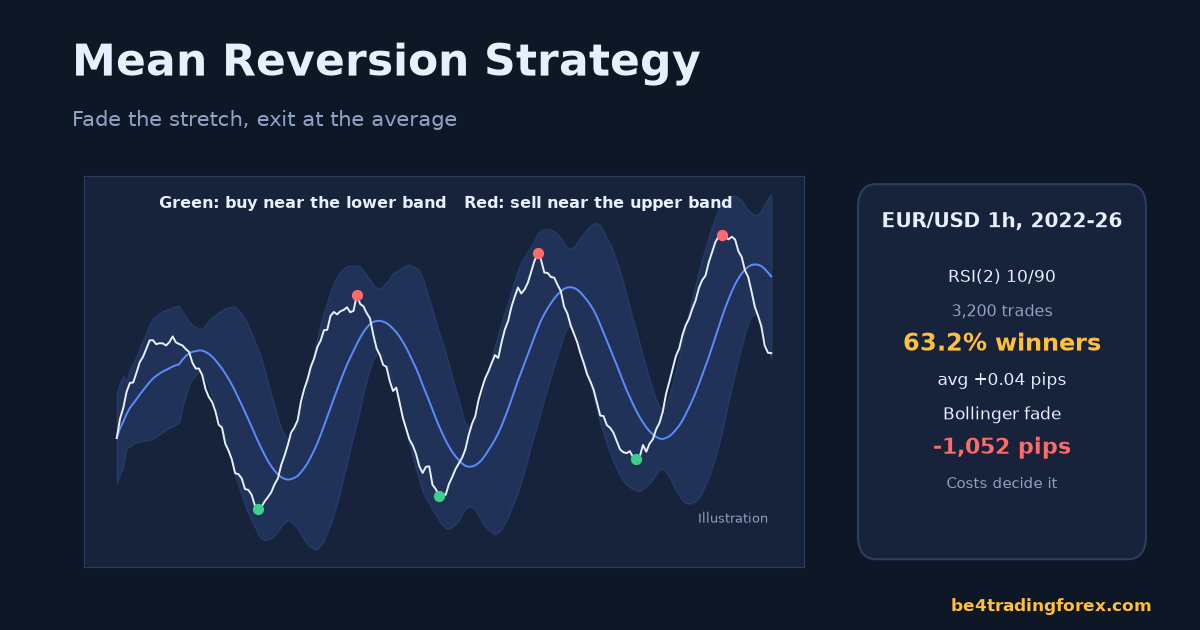
A mean reversion strategy bets that price will snap back toward its average after stretching too far: buy when it is unusually low, sell when it is unusually high. It wins often but each win is small, so costs and the occasional large loss decide the result. We tested two classic versions on five years of EUR/USD 1-hour candles. The RSI(2) strategy won 63.2% of its 3,200 trades but averaged only +0.04 pips a trade after a 1-pip cost; the Bollinger Band fade won 52.4% and lost 1,052 pips. Mean reversion needs a quiet, ranging market and very low trading costs.
What Mean Reversion Means
Prices wander around an average. When they move far from it in a short time, often on thin liquidity or a one-sided burst of orders, they tend to drift back. A mean reversion trader:
- defines the mean (a moving average, a VWAP, the middle of a range);
- defines stretched (an RSI extreme, a Bollinger Band touch, a distance in ATRs);
- takes the trade back toward the mean and exits there.
It is the opposite of trend following, which buys strength. Both can work, in different market conditions.
Two Popular Mean Reversion Strategies
| Strategy | Entry | Exit |
|---|---|---|
| RSI(2) | Buy when the 2-period RSI is below 10; sell when above 90 | When RSI(2) crosses back over 50, or after 10 candles |
| Bollinger fade | Buy a close below the lower band (20, 2); sell a close above the upper band | At the middle band, or after 10 candles |
What Our EUR/USD Data Shows
We used EUR/USD 1-minute data from HistData.com, January 2022 to November 2026 (New York time), built into 1-hour candles. Each trade was entered at the close of the signal candle, held until the exit rule or 10 hours, and charged 1 pip.
| EUR/USD 1-hour | Trades | Winners | Average win | Average loss | Per trade | Total |
|---|---|---|---|---|---|---|
| RSI(2) 10/90 | 3,200 | 63.2% | +10.4 pips | −17.7 pips | +0.04 pips | +128 pips |
| Bollinger 2-sigma fade | 1,319 | 52.4% | +23.3 pips | −27.3 pips | −0.8 pips | −1,052 pips |
- A high win rate is not profit. RSI(2) won almost two trades in three, but the average loss (17.7 pips) was much bigger than the average win (10.4 pips). After costs it barely broke even: +128 pips over 3,200 trades.
- Costs decide it. Before the 1-pip cost, RSI(2) would have made about +1 pip a trade. With a wider spread or slippage, it turns negative. See forex spreads explained.
- Fading the bands lost. A close outside a Bollinger Band often came at the start of a move, not the end. The Bollinger fade lost on average in Asia (−2.5 pips, 210 trades) and in the London-New York overlap (−1.95 pips, 529 trades); only the London morning was slightly positive (+0.72 pips, 552 trades).
- RSI(2) by session: Asia 63.4% winners, −0.3 pips a trade; London 3-8 AM ET 66.2%, −0.09 pips; 8 AM-5 PM ET 60.5%, +0.51 pips. No session gave a large edge.
When Mean Reversion Works and When It Fails
| Works better | Fails |
|---|---|
| Clear ranges between support and resistance | Strong trends and breakouts |
| Low ADX, quiet sessions | Around major news such as the jobs report |
| Tight spreads, low costs | Wide spreads, for example at the 5 PM ET rollover |
Rules That Make Mean Reversion Safer
- Always use a stop. The rare large loss is what ruins a high-win-rate system. A stop of 1 to 1.5 ATR caps it.
- Trade only in ranges. Skip signals when the higher timeframe is trending.
- Avoid news. Check the economic calendar and stand aside around big releases.
- Know your real cost. Add spread and commission per trade and test with them; judge the system by its expectancy, not its win rate.
- Never average down without limits. Adding to a loser until it reverts turns mean reversion into a martingale.
Frequently Asked Questions
Does mean reversion work in forex?
In our EUR/USD 1-hour test, simple mean reversion rules won often but made little or nothing after costs. It can work in ranges with very low costs and a stop, but it is not a free edge.
What is the RSI(2) strategy?
It uses a 2-period RSI, which swings to extremes quickly. Buy below 10, sell above 90, and exit when it returns past 50. It was made popular by Larry Connors for stock indexes.
Is mean reversion better than trend following?
Neither is better in all markets. Mean reversion suits ranges and gives many small wins; trend following suits trends and gives few large wins. Many traders use the ADX or the higher timeframe to choose.
Which timeframe is best for mean reversion?
Lower timeframes give more signals but higher costs per trade. We tested 1-hour candles; on 1-minute charts the spread usually takes the whole edge.
Why did the Bollinger Band fade lose?
A close outside the band often marks the start of a breakout. Without a range filter, the strategy kept selling into rallies and buying into drops.
General education, not financial advice. Forex trading involves substantial risk of loss and is not suitable for everyone. The test results above are hypothetical, based on past data and mechanical rules, and do not guarantee future results. Only trade money you can afford to lose.
Sources
- HistData.com, EUR/USD 1-minute bid data, January 2022 to November 2026 (our calculations).
- CFTC, Foreign currency trading fraud advisory.
- Code of Federal Regulations, 17 CFR Part 5 (retail forex rules).
Keep learning