What Is a Forex Trading Strategy? Types and How to Build One
A forex trading strategy is a written set of rules that decides which markets you trade, when you enter, where you place your stop-loss, when you take profit and how much you risk. Without one, every trade is a new improvisation and results cannot be measured or improved. This guide explains the main types of strategy, the components every strategy needs, how to build and test your own, and how to judge whether it works.
For ready-made examples, see 5 simple forex strategies for beginners, with complete rules and our test results on EUR/USD from 2022 to 2026.
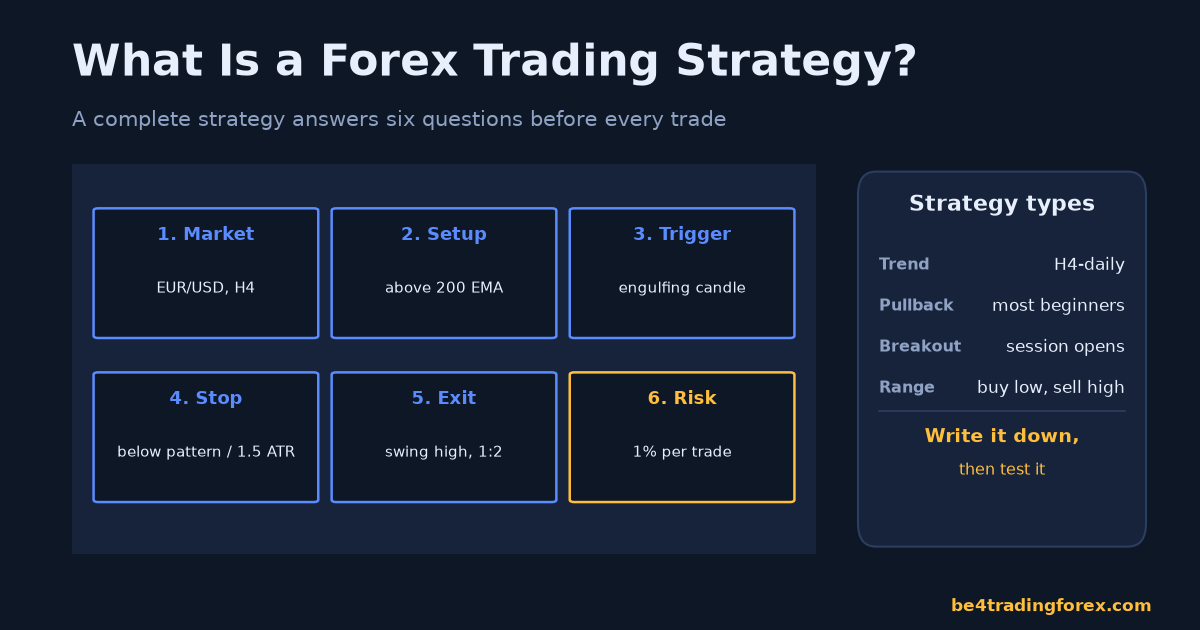
What Makes a Complete Strategy?
| Component | Question it answers | Example |
|---|---|---|
| Market and timeframe | What and when do I trade? | EUR/USD and GBP/USD on H4, London and New York sessions |
| Setup | When is a trade possible? | Price above the 200 EMA, pullback to support |
| Entry trigger | When exactly do I enter? | A bullish engulfing candle closes at support |
| Stop-loss | Where is the idea wrong? | Below the pattern low or 1.5 x ATR |
| Exit | When do I take profit? | The previous swing high, or a 1:2 risk-to-reward |
| Position size | How much do I risk? | 1% of the account per trade |
| Filters | When do I stay out? | No trades 30 minutes before high-impact news |
If any of these is missing, the strategy is incomplete and decisions will be made under pressure.
Main Types of Forex Strategies
| Type | Idea | Typical tools | Suits |
|---|---|---|---|
| Trend following | Trade in the direction of an established trend | Moving averages, Ichimoku, trendlines | Patient traders, H4-daily |
| Pullback | Enter a trend after a temporary move against it | Fibonacci, EMAs, support and resistance | Most beginners |
| Breakout | Enter when price leaves a range or level | Session ranges, triangles, volatility bands | Active traders around session opens |
| Range / mean reversion | Buy low and sell high inside a range | Support and resistance, RSI, Bollinger Bands | Quiet markets |
| Scalping | Many small trades lasting minutes | M1-M5 charts, EMAs, oscillators | Traders with time and low costs |
| Carry trade | Earn the interest-rate difference between two currencies | Swap rates, fundamental analysis | Long-term traders |
| News trading | Trade around economic releases | Economic calendar | Experienced traders |
For complete examples, see our guides to scalping, currency correlation and the breakout system roundup.
How to Build Your Own Strategy in 6 Steps
- Choose your style from the time you have. If you can check charts twice a day, H4 swing trading fits better than scalping.
- Pick one or two pairs with low spreads and learn how they move.
- Define the setup and trigger in words precise enough that another person would take the same trades.
- Set risk rules: stop placement, risk per trade (1% or less) and a daily loss limit.
- Write it down on one page.
- Test it on historical charts and then on a demo account before trading real money.
How to Test a Strategy
- Manual backtest: scroll back through charts and record every trade the rules would have taken, including the losers. MetaTrader’s strategy tester visual mode helps.
- Forward test on demo: trade the rules live on a demo account for at least a month.
- Sample size: judge results on at least 50-100 trades; ten trades prove nothing.
- Include costs: spreads, commissions and swaps change results, especially for short-term strategies.
Judging Whether a Strategy Works
| Measure | What it tells you |
|---|---|
| Win rate | Share of trades that are profitable |
| Average win / average loss | Whether winners are big enough to pay for losers |
| Expectancy | (Win rate x average win) – (loss rate x average loss): the average result per trade |
| Maximum drawdown | The worst peak-to-trough fall; can you live with it? |
| Longest losing streak | How many losses in a row to expect |
Example: a strategy that wins 45% of trades, with an average win of 2R and an average loss of 1R, has an expectancy of 0.45 x 2 – 0.55 x 1 = +0.35R per trade before costs. A strategy with a 70% win rate can still lose money if its losses are much larger than its wins.
Common Mistakes
- Changing strategy after a few losses, before it has had a fair sample.
- Over-optimising settings until they fit the past perfectly.
- Vague rules such as “buy when it looks strong”.
- Buying strategies or signals that promise fixed returns.
- No risk rules, which makes even a good strategy dangerous.
Sources and Further Reading
- Van K. Tharp, Trade Your Way to Financial Freedom (2nd ed., 2007), on expectancy and system design.
- Related guides: how to make a trading plan, risk management and technical analysis.
Frequently Asked Questions
What is the best forex strategy for beginners?
A simple trend pullback strategy on H4 or daily charts: trade in the direction of the trend, enter at support on a clear candle signal, risk 1% per trade.
How long does it take to know if a strategy works?
Usually 50-100 trades, which can take weeks for a scalper and many months for a swing trader. Backtesting speeds this up.
Should I combine several strategies?
Start with one. Once it is tested and followed consistently, a second strategy for different market conditions (for example ranges) can be added.
Is a high win rate important?
Not on its own. What matters is expectancy: the combination of win rate and the size of wins compared with losses.
Keep learning