Common Forex trading mistakes and traps
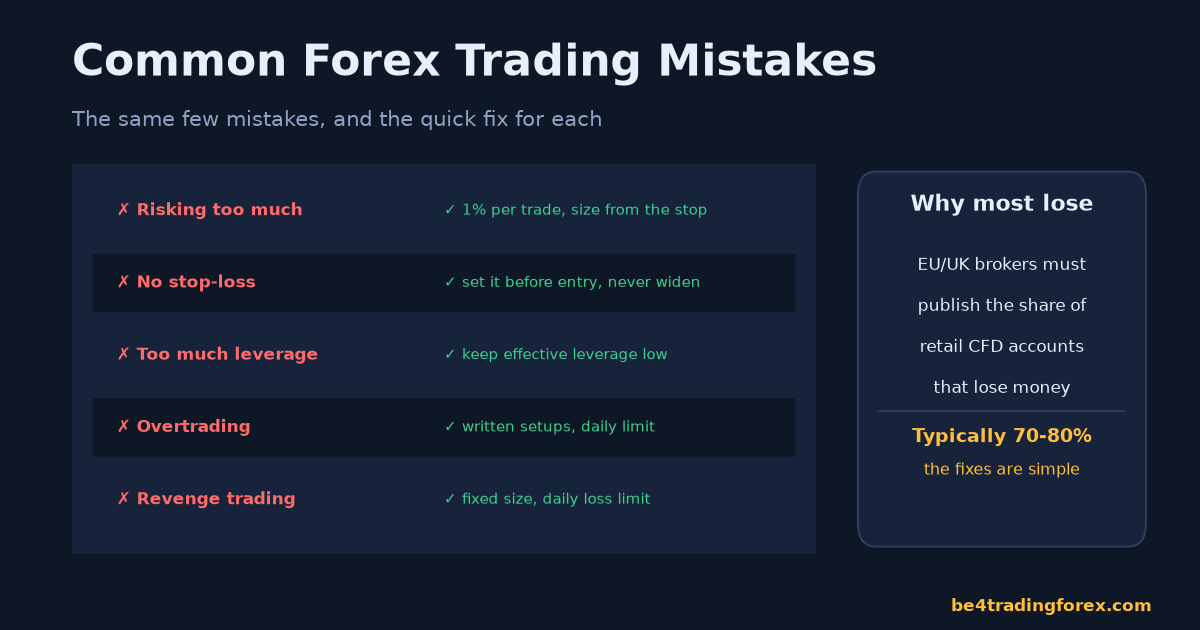
Most retail forex traders lose money. Brokers regulated in the EU and UK must publish the share of their retail CFD accounts that lose money, and the figures are typically between 70% and 80%. The reasons are rarely mysterious: the same handful of mistakes, repeated, account for most losses. This guide lists the most common forex trading mistakes and traps, explains why each one is so damaging, and gives a practical fix for each, plus a checklist you can use before every trade.
Why Most Traders Lose
Three forces work against new traders. Costs (spreads, commissions, swaps) mean an average trade starts slightly negative. Leverage makes every mistake larger. And human psychology pushes us to take small profits quickly and hold losses in the hope they recover, which is the opposite of what a profitable system needs. Fixing these mistakes will not guarantee profits, but it removes the main reasons accounts are destroyed.
Mistake 1: Risking Too Much per Trade
Why it hurts: at 10% risk per trade, ten losses in a row, which happen to most strategies eventually, leave about a third of the account. At 1%, they leave about 90%.
Fix: risk 1% (at most 2%) per trade and size positions from the stop distance. Our risk management guide shows the formula.
Mistake 2: Trading Without a Stop-Loss
Why it hurts: one unexpected news spike or weekend gap can cause a loss many times larger than usual, wiping out weeks of gains.
Fix: place the stop before entering, at a level where the trade idea is clearly wrong, and never widen it.
Mistake 3: Using Too Much Leverage
Why it hurts: high leverage allows huge positions relative to the account, so a small move against you causes a margin call or stop-out.
Fix: ignore the maximum leverage on offer and keep effective leverage (total position size divided by equity) low. See the leverage guide.
Mistake 4: Overtrading
Why it hurts: taking trades out of boredom or to “make the day’s target” means taking low-quality setups and paying more costs.
Fix: write down exactly what a valid setup looks like and set a maximum number of trades per day.
Mistake 5: Revenge Trading and Doubling Down
Why it hurts: increasing size after a loss to win it back quickly turns a normal losing streak into a disaster. Systems that double after every loss, such as the martingale strategy, eventually meet a losing run long enough to empty the account.
Fix: keep position size fixed by your risk rule, and stop trading for the day after a set loss (for example 3%).
Mistake 6: Cutting Winners and Letting Losers Run
Why it hurts: if your average loss is larger than your average win, you need a very high win rate just to break even.
Fix: set targets of at least 1.5 times the risk, and use a trailing stop instead of closing early out of fear.
Mistake 7: No Trading Plan
Why it hurts: without written rules, every decision is made under pressure and results cannot be measured or improved.
Fix: write a plan covering markets, timeframes, entry rules, stop and target rules, risk per trade and daily limits. Our guide on how to make a trading plan gives a template.
Mistake 8: Trading Through Major News Without a Plan
Why it hurts: around high-impact releases such as central bank decisions or US Non-Farm Payrolls, spreads widen and stops can slip far beyond their level.
Fix: check the economic calendar before each session and either stay out or reduce size around high-impact events.
Mistake 9: Indicator Overload and Strategy Hopping
Why it hurts: piling up indicators gives conflicting signals, and switching strategy after every few losses means never learning whether any of them work.
Fix: use one simple strategy with one or two indicators that measure different things, and judge it on at least 50-100 trades.
Mistake 10: Skipping the Demo Account
Why it hurts: real money is the most expensive way to learn the platform, order types and your own reactions.
Fix: practise on a free demo account until you follow your rules consistently, then start live with small size.
Mistake 11: Choosing the Wrong Broker
Why it hurts: unregulated brokers may manipulate prices, refuse withdrawals or disappear with client funds.
Fix: choose a broker authorised by a recognised regulator (for example the FCA, CySEC, ASIC, FSCA in South Africa or the CMA in Kenya) and check the licence number on the regulator’s website.
Mistake 12: Falling for Signal Sellers and “Guaranteed” Systems
Why it hurts: paid signal groups, “account managers” and robots promising fixed monthly returns are a common source of losses and fraud, especially on social media.
Fix: treat any promise of guaranteed or very high regular returns as a warning sign. Never give anyone access to your trading account or send money to individuals offering to trade for you.
Mistake 13: Not Keeping a Trading Journal
Why it hurts: without records, you repeat the same mistakes without noticing them.
Fix: record every trade (pair, setup, entry, stop, target, size, result and how you felt) and review the journal each week.
Related reading: Many of these mistakes come from trading without a defined method; see what a complete trading strategy includes and how professional forex traders work.
Summary Table
| Mistake | Quick fix |
|---|---|
| Risking too much | 1% per trade, size from the stop |
| No stop-loss | Set it before entry, never widen it |
| Too much leverage | Keep effective leverage low |
| Overtrading | Written setups, daily trade limit |
| Revenge trading | Fixed size, daily loss limit |
| Small wins, big losses | Targets of 1.5R or more, trailing stops |
| No plan | Write one and follow it |
| Trading news blindly | Check the calendar every session |
| Indicator overload | One strategy, one or two indicators |
| Skipping demo | Practise until rules are automatic |
| Unregulated broker | Check the licence with the regulator |
| Signal sellers and scams | Reject guaranteed returns |
| No journal | Record and review every trade |
Pre-Trade Checklist
- Is this setup written in my plan?
- Is the stop-loss set at a logical level, and is my risk 1% or less?
- Is the risk-to-reward at least 1:1.5?
- Is there high-impact news before the trade can work?
- Am I calm, or trading to recover a loss?
Watch: Why Most Forex Traders Lose Money (Video)
A short video on the most common reasons traders lose:
Already lost money to a scam? Follow our step-by-step guide on how to recover money from a forex scam, and beware of paid “recovery” offers.
Sources and Further Reading
- ESMA, measures on CFDs for retail clients (2018), including the standard retail loss-rate risk warning.
- Mark Douglas, Trading in the Zone (2000), on the psychology behind most trading mistakes.
- Van K. Tharp, Trade Your Way to Financial Freedom (2nd ed., 2007), on position sizing.
Frequently Asked Questions
What is the biggest mistake new forex traders make?
Risking too much per trade, usually combined with high leverage and no stop-loss. It turns normal losing streaks into account-ending losses.
Why do 70-80% of retail traders lose money?
Mainly because of costs, excessive leverage and poor risk management, made worse by emotional decisions such as revenge trading and holding losers.
How can I stop revenge trading?
Set a daily loss limit and a maximum number of trades in advance, and step away from the screen when either is reached.
How do I recognise a forex scam?
Promises of guaranteed or fixed high returns, pressure to deposit quickly, requests to send money to individuals and brokers without a verifiable licence are the most common warning signs.
Keep learning